USAID DEC
Strengthening Economic and Social Resilience for Vulnerable Entrepreneur Women to Respond to the COVID-19 Effects
Sign inUSAID
Strengthening Economic and Social Resilience for Vulnerable Entrepreneur Women to Respond to the COVID-19 Effects
The Women's Entrepreneurship and Resilience Project for Women was implemented in the Metropolitan Area of Asunción, Paraguay, from August 2020 to August 2023.
2023 · 79 pages
Sign in to readA free account is required to download.
Abstract
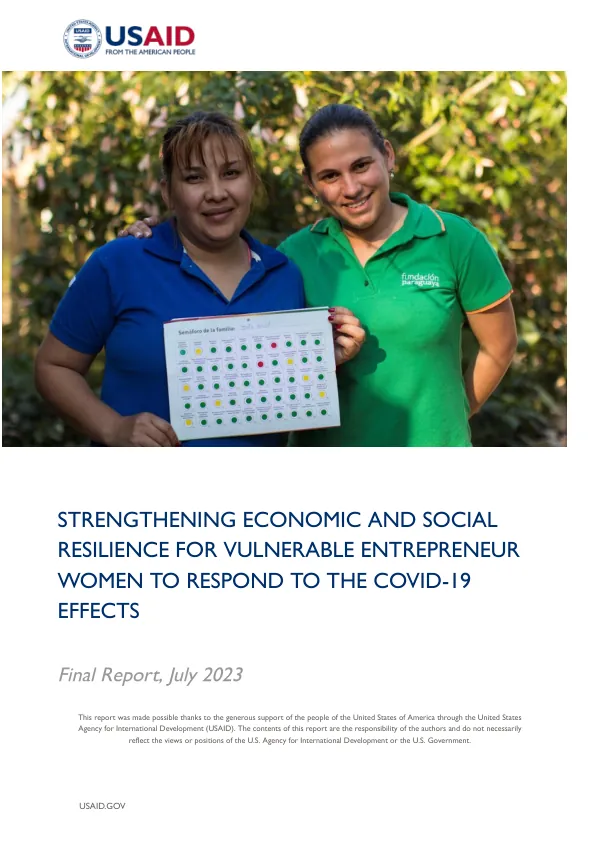
Fundación Paraguaya, the project implementer, aimed to empower women through microcredit and mentorship, particularly in the context of the COVID-19 pandemic. The project's utilization of the Poverty Stoplight methodology played a pivotal role in identifying the priorities of the participants and guiding the provision of targeted support. The project's main achievements include the creation and strengthening of women's committees, which were developed for women and mothers. These groups are based on the community banking methodology and access loans with a solidarity guarantee, generating additional income, operating capital, and encouraging savings among the participants. The project also created and strengthened microenterprises, with the expectation that through the provision of mentoring, training, assistance in developing business plans, and the granting of revolving loan funds, these microenterprises would overcome obstacles caused by the pandemic. The project provided short-, medium-, and long-term loans to individual microenterprises and women's committees that do not qualify for traditional financial services or are otherwise considered high risk. Borrowers are typically micro and small producers of goods and services and small farmers with little or no credit history or access to other types of loans from financial institutions. This project provided loan funds to help strengthen businesses impaired by the effects of the COVID-19 pandemic, by supporting new businesses, and supporting entrepreneurs through micro franchises. The project's implementation was facilitated by the use of a client management application called "Digital Portfolio", which is used by field staff to enable credit management, including geo-referencing of each committee member and monitoring. The tool also has socioeconomic information on each entrepreneur. This technology, along with the self-assessment survey (Poverty Stoplight), allows each entrepreneur to provide information on where she lives, a general understanding of her income, family composition, business activity, as well as some questions about the condition of the home. This baseline survey allowed Fundación Paraguaya to measure the impact of the project using a second measurement (survey) of the indicators after the intervention. One of the remarkable outcomes of the project was the significant contribution of the committees to their communities. They took on responsibilities that were traditionally the responsibility of the local or central government. The committees initiated various community development activities, such as paving streets, installing lighting, organizing training courses to develop income-generating skills, improving public spaces, establishing soup kitchens, creating micro-enterprises, and mobilizing resources to support vulnerable groups like the elderly, single mothers, and sick neighbors. The project's planned results have been met, with the achievement of all the indicators set forth in the project's Monitoring, Evaluation and Learning Plan (MEL PLAN). The project achieved 100% compliance in several areas, including economic and social livelihood improvements, strengthened economic and social networks, and women's committees created. The project also achieved significant results in other areas, including families with increased income, strengthened microenterprises, and resources mobilized. The project's success can be attributed to the effective implementation of the Poverty Stoplight methodology, which allowed for the identification of the priorities of the participants and the provision of targeted support. The project's use of technology, including the "Digital Portfolio" application, also played a crucial role in facilitating the project's implementation and monitoring. The project's outcomes demonstrate the potential of microcredit and mentorship programs in empowering women and promoting economic and social development in vulnerable communities.
Related documents