USAID DEC
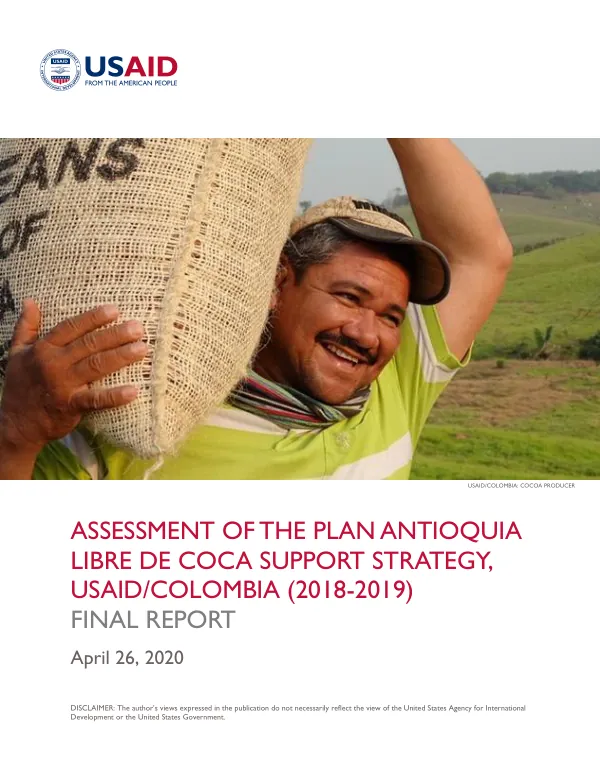
Assessment of the Plan Antioquia Libre de Coca Support Strategy, USAID/Colombia (2018-2019)
Sign inGOVERNMENT OF COLOMBIA
Assessment of the Plan Antioquia Libre de Coca Support Strategy, USAID/Colombia (2018-2019)
The Plan Antioquia Libre de Coca (PALC) is a departmental public policy implemented in the Bajo Cauca Antioqueño region of Colombia.
2020 · 125 pages
Sign in to readA free account is required to download.
Abstract
The policy was adopted through Ordinance 39 of the Departmental Assembly in October 2017 and officially launched on December 14, 2017. The PALC public policy was developed with the participation of the Antioquia Governor's Office, the Presidency of the Republic, the Military Forces, and the National Police, and had the support of the US Embassy. USAID started to implement its own PALC support strategy in January 2018, which comprises three objectives: municipal capacity strengthened to withstand increased pressures from criminal groups, licit economy strengthened to reduce dependence on cocoa cultivation, and delivery of public services improved. USAID supports the PALC through a total of 19 implementation mechanisms, 14 activities, and 5 Development Alliances (GDAs), the latter were signed in 2019. The assessment methodology used a mixed methods design with qualitative and quantitative data collection to address the research questions. Quantitative data were collected using secondary sources, mainly information from the Government of Colombia (GOC) and the USAID/Colombia MONITOR database. Qualitative data was obtained through transcripts from participatory workshops, semi-structured interviews, and focus groups. The assessment found that the PALC implementation has achieved significant progress in the region. The policy has helped to reduce the presence of illicit crops, improve the delivery of public services, and strengthen the licit economy. However, the assessment also identified challenges and limitations, including the need for further strengthening of municipal capacity and the delivery of public services. The assessment concludes that the PALC regional integration model has been successful in achieving its objectives, but there are opportunities for improvement. The model has been effective in promoting collaboration and coordination among government entities, the private sector, and civil society organizations. However, there is a need for further strengthening of the model to address the challenges and limitations identified. The assessment recommends that USAID/Colombia continue to support the PALC implementation and strengthen the regional integration model. The recommendations include: * Continuing to support the PALC implementation through the 19 implementation mechanisms, 14 activities, and 5 Development Alliances (GDAs) * Strengthening municipal capacity to withstand increased pressures from criminal groups * Improving the delivery of public services in the region * Enhancing the licit economy to reduce dependence on cocoa cultivation * Further strengthening the regional integration model to address the challenges and limitations identified The assessment also recommends that USAID/Colombia use common indicators to track progress under PALC, including the reduction of illicit crops, improvement of public services, and strengthening of the licit economy. The assessment concludes that the PALC regional integration model has the potential to be replicated in other regions of Colombia, and that USAID/Colombia should consider this option in its future programming.