USAID DEC
USAID's Natural Wealth Program: Empowering Women in Colombia's Tropical Dry Forests and Flooded Savannas
Sign inCHEMONICS
USAID's Natural Wealth Program: Empowering Women in Colombia's Tropical Dry Forests and Flooded Savannas
Colombian women have played a critical role in leading public institutions focused on protecting the country's natural resources and biodiversity at the national level.
2019 · 4 pages
Sign in to readA free account is required to download.
Abstract
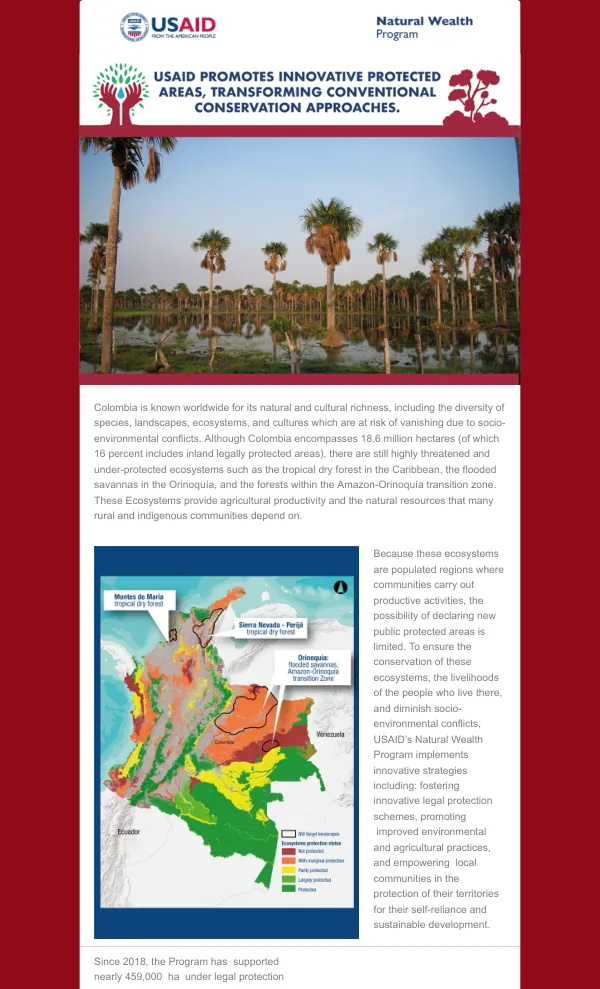
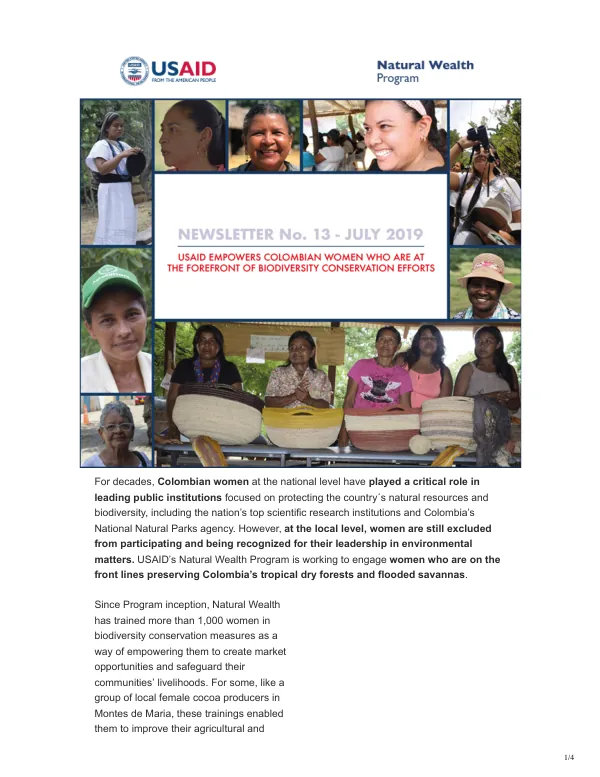
However, at the local level, women are still excluded from participating and being recognized for their leadership in environmental matters. USAID's Natural Wealth Program is working to engage women who are on the front lines preserving Colombia's tropical dry forests and flooded savannas. Since the program's inception, Natural Wealth has trained more than 1,000 women in biodiversity conservation measures as a way of empowering them to create market opportunities and safeguard their communities' livelihoods. For some women, like a group of local female cocoa producers in Montes de Maria, these trainings enabled them to improve their agricultural and environmental practices. As a result, the Compañía Nacional de Chocolates is buying part of their cocoa at a higher price. For others, this support was key to breaking the glass ceiling as they are now conducting activities traditionally done by men. In the Orinoquía, a male-dominated region, Maria Lucila Reyes leads the local cattle-rancher association in Casanare. Natural Wealth works with her and the association to adopt improved agricultural and environmental practices to enhance both the flooded savanna ecosystem and beef productivity. Maria Lucila has been an advocate of female involvement in this activity and as a result, 50 percent of the participants are now women. Through this initiative, these women are opening the door to other local women interested in becoming cattle ranching managers who emphasize conservation practices. Several experiences worldwide have demonstrated that when women partake in decision making of their communities' natural resources, it leads to better land and livelihood management. In Montes de María, Natural Wealth is implementing a citizen science pilot activity with women from a local women's association, AMUSI, who want to deepen their knowledge and leadership about the territory's natural wealth and biodiversity to promote their region as a nature-based tourism destination. More than 25 women participated in this activity, which now serves as a regional example for biodiversity research and conservation.