USAID
Strengthening Human Resources for Health (HRH) project
The Strengthening Human Resources for Health (HRH) project, funded by USAID, focused on training Human Resources leaders and managers on fundamental human resource management practices, including HR policy, budgeting, staff motivation and retention, evidence-based employee data management, and leadership.
2019 · 1 pages
Sign in to readA free account is required to download.
Abstract
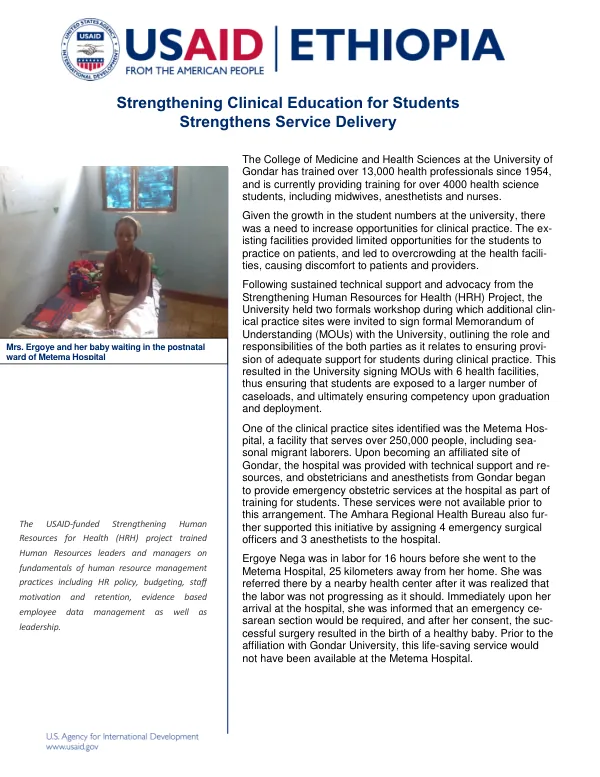
The project aimed to strengthen the capacity of health institutions to manage their human resources effectively. The College of Medicine and Health Sciences at the University of Gondar has a long history of training health professionals, with over 13,000 health professionals trained since 1954. Currently, the university provides training for over 4,000 health science students, including midwives, anesthetists, and nurses. However, the growth in student numbers led to a need to increase opportunities for clinical practice. The existing facilities provided limited opportunities for students to practice on patients, resulting in overcrowding at the health facilities and discomfort to patients and providers. Following sustained technical support and advocacy from the Strengthening Human Resources for Health (HRH) Project, the University held two formal workshops to invite additional clinical practice sites to sign Memoranda of Understanding (MOUs) with the University. This resulted in the University signing MOUs with six health facilities, ensuring that students are exposed to a larger number of caseloads and ultimately ensuring competency upon graduation and deployment. One of the clinical practice sites identified was the Metema Hospital, a facility that serves over 250,000 people, including seasonal migrant laborers. The Metema Hospital, upon becoming an affiliated site of Gondar University, was provided with technical support and resources. Obstetricians and anesthetists from Gondar began to provide emergency obstetric services at the hospital as part of training for students. These services were not available prior to this arrangement. The Amhara Regional Health Bureau further supported this initiative by assigning four emergency surgical officers and three anesthetists to the hospital. The affiliation with Gondar University resulted in the availability of life-saving services, such as emergency cesarean sections, at the Metema Hospital. Ergoye Nega, a patient, was in labor for 16 hours before she went to the Metema Hospital, 25 kilometers away from her home. She was referred there by a nearby health center after it was realized that the labor was not progressing as it should. Immediately upon her arrival at the hospital, she was informed that an emergency cesarean section would be required, and after her consent, the successful surgery resulted in the birth of a healthy baby. Prior to the affiliation with Gondar University, this life-saving service would not have been available at the Metema Hospital.
Related documents
Documents in this collection
 2019
2019USAID DEC
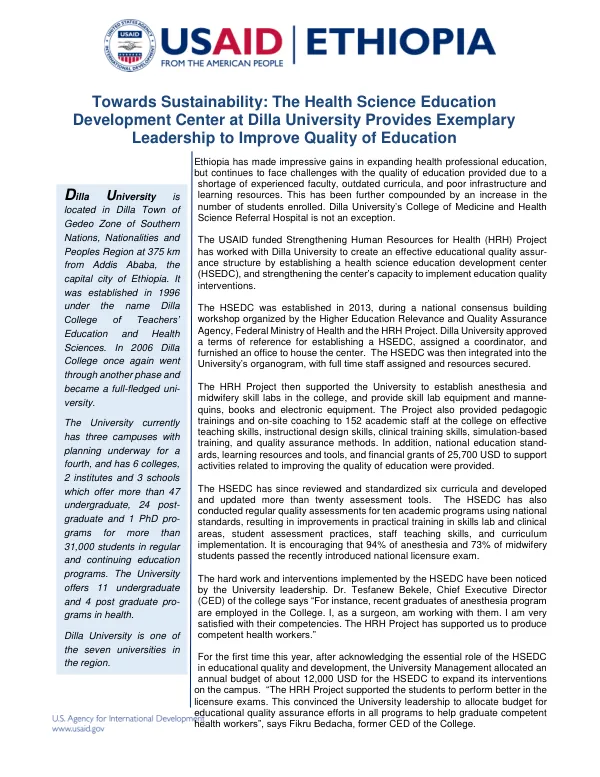
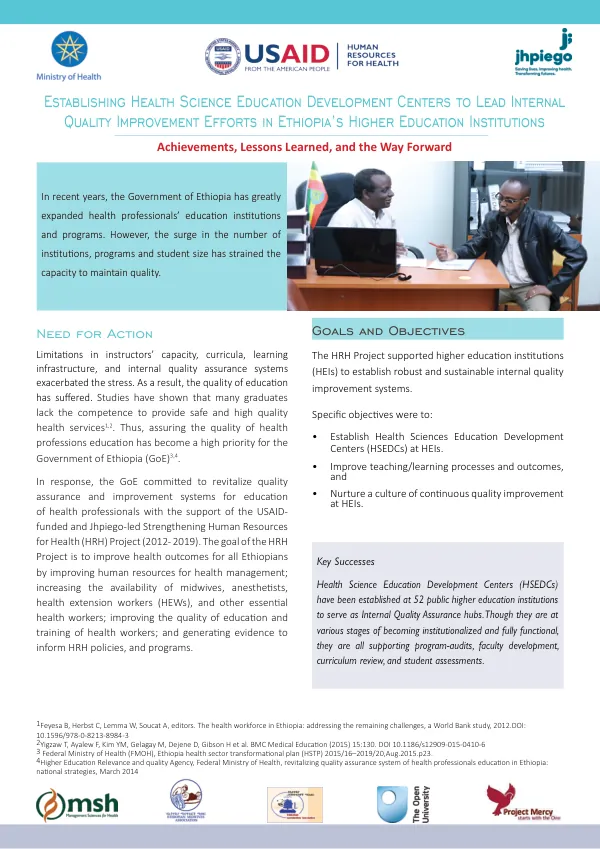
Establishing Health Science Education Development Centers to Lead Internal Quality Improvement Efforts in Ethiopia’s Higher Education Institutions
Open record 2021
2021USAID DEC
Rapid Feedback Monitoring, Evaluation, Research, and Learning FY21 Quarter 1: October 1 – December 31, 2020
Open record