USAID DEC
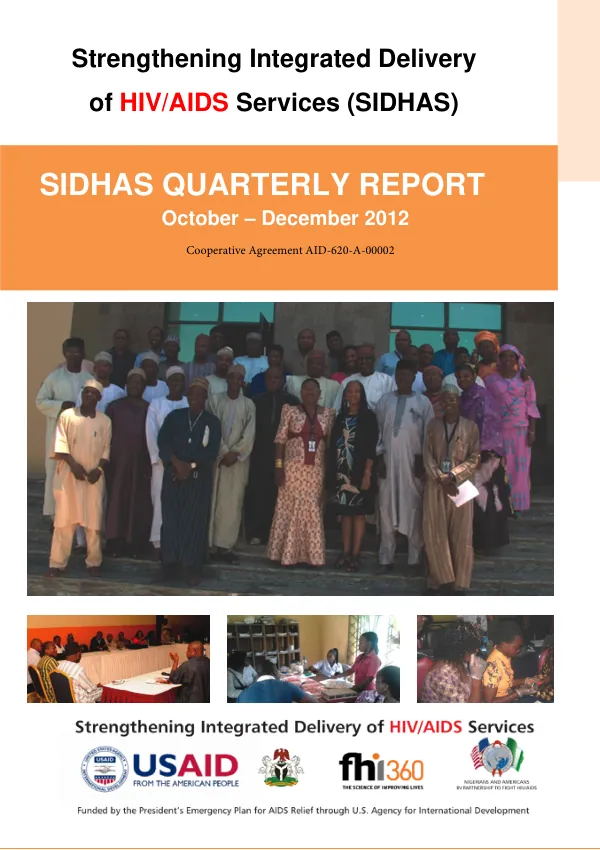
Strengthening Integrated Delivery of HIV/AIDS Services (SIDHAS) Quarterly Report October – December 2012
Sign inFAMILY HEALTH INTERNATIONAL
Strengthening Integrated Delivery of HIV/AIDS Services (SIDHAS) Quarterly Report October – December 2012
The SIDHAS project, implemented by Family Health International (FHI 360), aims to sustain cross-sectional integration of HIV/AIDS and TB services in Nigeria.
2012 · 34 pages
Sign in to readA free account is required to download.
Abstract
The project's objective is to build Nigerian capacity to deliver sustainable high-quality, comprehensive prevention, treatment, care, and related services. This will be achieved through three key result areas: increased access to high-quality HIV/AIDS and TB services, improved cross-sectional integration of high-quality HIV/AIDS and TB services, and improved stewardship by Nigerian institutions for the provision of high-quality comprehensive HIV/AIDS and TB services. The project is funded by the President's Emergency Plan for AIDS Relief through the U.S. Agency for International Development (USAID) and is aligned with USAID's Assistance Objective 3 (AO 3): A sustained, effective Nigerian-led HIV/AIDS and TB response. The project's life span is from September 12, 2011, to September 11, 2016. The quarterly report for October to December 2012 highlights the project's progress in various program areas, including Prevention of Mother-to-Child Transmission (PMTCT), Medical Prevention, Sexual Prevention, Basic Care and Support, Orphans and Vulnerable Children (OVC), Anti-Retroviral Therapy (ART), HIV Testing and Counseling (HTC), TB/HIV Collaboration, Laboratory Services, Pharmacy Services, Drugs and Commodity Logistics, Health Systems Strengthening, Strategic Information, Gender Mainstreaming, and Program Management. In the quarter under review, FHI 360 and its partners focused on realigning the SIDHAS project operations with the United States and Nigeria governments' agenda for rationalizing HIV/AIDS treatment programs in the country. The project will restrict its operations to the 16 assigned states, effective from the second half of the second year. To facilitate the transition, the project set up a rationalization committee and developed a roll-out plan to ensure a smooth transition from 36 states and the Federal Capital Territory (FCT) to the 16 states. Key activities carried out to facilitate the transition include dialogue with Management Sciences for Health (MSH)/ProACT on the transition process, sensitization of stakeholders about the upcoming change, and revision of the year 2 work plan. The project's progress in specific program areas is also highlighted in the quarterly report. In PMTCT, the project achieved a 95% coverage rate for HIV testing among pregnant women, while in Medical Prevention, the project distributed 10,000 condoms to high-risk groups. In Sexual Prevention, the project conducted 500 peer educator trainings, and in Basic Care and Support, the project provided psychosocial support to 1,000 orphans and vulnerable children. The project also made significant progress in ART, HTC, TB/HIV Collaboration, Laboratory Services, Pharmacy Services, Drugs and Commodity Logistics, Health Systems Strengthening, Strategic Information, Gender Mainstreaming, and Program Management. Overall, the SIDHAS project continues to make significant progress in its efforts to sustain cross-sectional integration of HIV/AIDS and TB services in Nigeria. The project's focus on rationalizing HIV/AIDS treatment programs and restricting its operations to the 16 assigned states is a key strategy to ensure the project's sustainability and effectiveness.
Related documents