USAID DEC
Strengthening Organizational Capacity for Delivery of Mental Health and Psychosocial Support Services in Humanitarian Settings through Training and Mentoring: Semi-Annual Report No. 1
Sign inINTERNATIONAL MEDICAL CORPS
Strengthening Organizational Capacity for Delivery of Mental Health and Psychosocial Support Services in Humanitarian Settings through Training and Mentoring: Semi-Annual Report No. 1
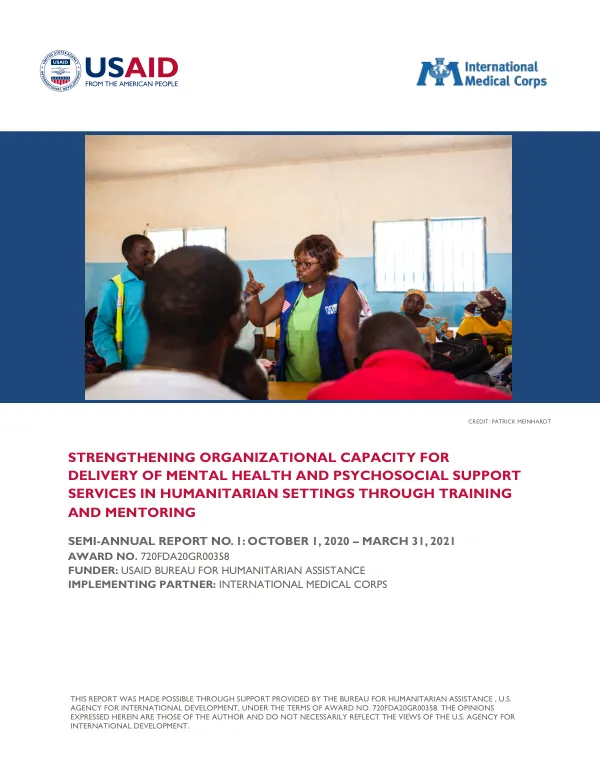
The "Strengthening Organizational Capacity for Delivery of Mental Health and Psychosocial Support Services in Humanitarian Settings through Training and Mentoring" project aims to reduce suffering and improve mental health and psychosocial wellbeing among people affected by emergencies.
2021 · 45 pages
Sign in to readA free account is required to download.
Abstract
Funded by USAID's Bureau for Humanitarian Assistance, the project will accomplish this goal through global capacity building and a comprehensive case study outlining the processes involved in adapting or designing remote MHPSS delivery in humanitarian settings. The project will focus on two main components. Component I involves building the capacity of non-specialists to offer critical support through the mhGAP Humanitarian Intervention Guide (mhGAP-HIG) and its operations manual. The project will conduct a global mhGAP-HIG Capacity Building Workshop, which will be followed by a 6-month capacity building phase with tailored mentoring and technical supervision from International Medical Corps. The workshop will build humanitarian workers' capacity in mhGAP-HIG project design and service implementation, as well as clinical assessment and management through a Training of Trainers and Supervisors (TOTS). Component II involves evaluating International Medical Corps' MHPSS programs in five countries and documenting learning on how best to design and adapt remote MHPSS training, service delivery, and supervision in diverse humanitarian settings. The resulting guidance document will expand upon the International Medical Corps Guidelines for MHPSS Staff Providing Tele-MHPSS to Clients during the COVID-19 Pandemic and will include successes, challenges, lessons, and recommendations to create a stepwise approach that contributes to increased and improved remote MHPSS uptake globally in humanitarian settings. The project team was finalized in December 2020, with the Global MHPSS Capacity Building Project Manager Afa Alizada and the Global MHPSS Capacity Building Dr. Fuat Elmusa onboarded in late December 2020 and early January 2021, respectively. The International Medical Corps' four-member Global MHPSS Technical Unit team was oriented to the project in January 2021. Due to the ongoing COVID-19 pandemic, the project activities' delivery format and timelines were adjusted, with the Global mhGAP-HIG Capacity Building Workshop shifted to a virtual delivery format and postponed until March 2021. The timeline for the Remote MHPSS Guidelines Case Study was also postponed to ensure field work is undertaken after the project team members are vaccinated against COVID-19. The project team proposed some ideas for re-programming the savings resulting from the transition to a virtual format and the resulting delay in launching the activities. Based on the USAID/BHA team's feedback, the project team developed a formal request summarizing the proposed ideas and submitted it to the AOR for concurrence. The AOR concurrence was received in early March 2021. The proposed activities to reprogram the savings are included in Annex B of this report. The project will be conducted in five countries, including Central African Republic, Iraq, Libya, South Sudan, and Venezuela. The case study will be conducted through a consultative process in each country, with MHPSS in-country focal points, field teams based in the community, program management, and beneficiaries invited to participate in interviews and focus group discussions. The project aims to contribute to increased and improved remote MHPSS uptake globally in humanitarian settings.