ENVIRONMENTAL INCENTIVES, LLC
USAID Ecuador 118/119 Analysis Final Report
The USAID Ecuador 118/119 Analysis is a comprehensive report that assesses the status of Ecuador's tropical forests and biodiversity.
2020 · 129 pages
Sign in to readA free account is required to download.
Abstract
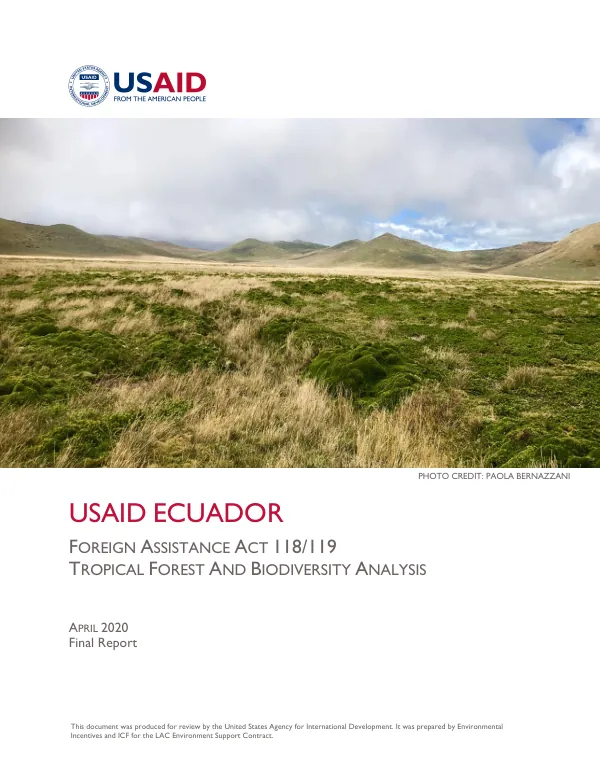
The report was prepared by Environmental Incentives and ICF for the LAC Environment Support Contract, with funding from the United States Agency for International Development (USAID) under the terms of its requisition number REQ-LAC-19-000022. The report's purpose and scope are to provide an analysis of Ecuador's tropical forests and biodiversity, with a focus on the country's major ecosystem regions, tropical forest types, species diversity, genetic diversity, and protected areas. The report also examines the value and economic potential of biodiversity, the legal framework affecting conservation and natural resource management, and the threats to tropical forests and biodiversity. Ecuador is located in the northwest of South America, bordering the Pacific Ocean to the west and the Amazon rainforest to the east. The country's biophysical setting is characterized by a diverse range of ecosystems, including tropical rainforests, cloud forests, and dry forests. The report notes that Ecuador's tropical forests cover approximately 50% of the country's land area, with the majority of these forests located in the Amazon region. The report's analysis of Ecuador's tropical forests and biodiversity reveals that the country's forests are facing significant threats, including deforestation, habitat fragmentation, and climate change. The report notes that Ecuador's protected areas cover approximately 20% of the country's land area, but these areas are often fragmented and lack effective management. The report also highlights the importance of biodiversity in Ecuador, with the country being home to a rich array of plant and animal species, including many that are found nowhere else in the world. The report's analysis of the value and economic potential of biodiversity in Ecuador reveals that the country's natural resources have significant economic value, including timber, non-timber forest products, and ecotourism. The report notes that Ecuador's biodiversity also provides important ecosystem services, including carbon sequestration, water filtration, and soil conservation. The report's examination of the legal framework affecting conservation and natural resource management in Ecuador reveals that the country has a range of laws and policies in place to protect its natural resources, including the Organic Code on the Environment (COA) and the Forest Law. However, the report notes that these laws and policies are often poorly enforced, and that there are significant gaps in the country's conservation efforts. The report's analysis of the threats to Ecuador's tropical forests and biodiversity reveals that the country's forests are facing significant threats, including deforestation, habitat fragmentation, and climate change. The report notes that these threats are driven by a range of factors, including agricultural expansion, urbanization, and mining. The report's recommendations for conserving Ecuador's tropical forests and biodiversity include strengthening the country's legal framework, improving the management of protected areas, and promoting sustainable land-use practices. The report also recommends that USAID support the development of a national conservation strategy, and that the country's government and civil society organizations work together to address the threats facing Ecuador's tropical forests and biodiversity. Overall, the USAID Ecuador 118/119 Analysis provides a comprehensive assessment of the status of Ecuador's tropical forests and biodiversity, and highlights the importance of conserving these natural resources for future generations. The report's recommendations provide a roadmap for addressing the threats facing Ecuador's tropical forests and biodiversity, and for promoting sustainable development in the country.