USAID DEC
Establishing an MPA Network and Advancing Sustainable Fisheries Management in North Maluku
Sign inGOVERNMENT OF INDONESIA
Establishing an MPA Network and Advancing Sustainable Fisheries Management in North Maluku
Established in 1999, North Maluku is one of Indonesia's newest provinces.
2021 · 24 pages
Sign in to readA free account is required to download.
Abstract
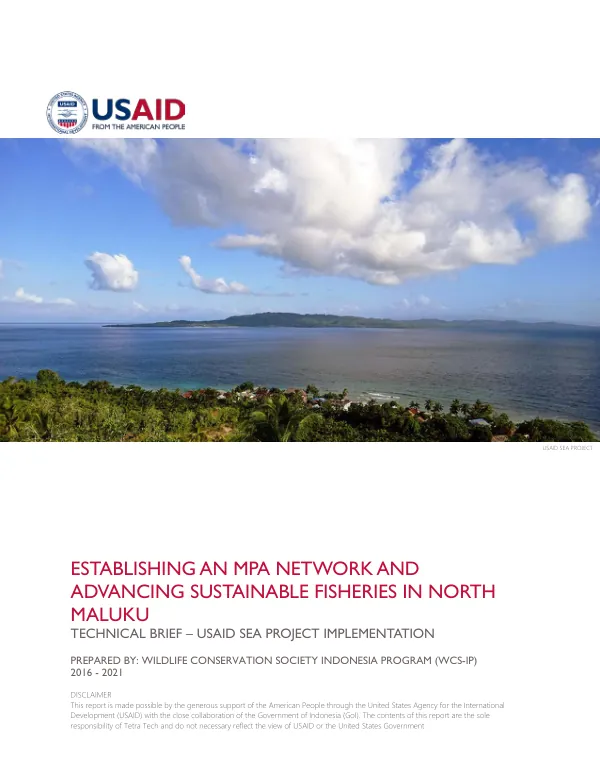
It is a maritime province, with 806 islands that span 12.4 million ha, of which 78% is ocean. The province has three major coastal ecosystems: coral reef (covering 52,100 ha); seagrass (33,300 ha); and, mangrove (42,800 ha), which store an estimated 164 million tons of CO2 in its blue carbon ecosystems. North Maluku has rich stocks of snapper, grouper, emperor fish, small pelagic fish, and tuna, which form the basis of the local economy of the province's 1.2 million people, who are primarily fishers. However, these fish stocks and coastal and marine ecosystems are threatened by overfishing, destructive fishing, illegal unreported and unregulated (IUU) fishing, bycatch and poaching of Endangered, Threatened, and Protected species, habitat destruction and conversion, and marine pollution. To address these threats, the USAID Indonesia Sustainable Ecosystems Advanced (SEA) Project was designed to support provincial, district, and village governments through developing science-based and inclusive marine spatial plans, community engagement, and enacting various responses to reduce destructive fishing practices. The USAID SEA Project is a five-year initiative that aimed to conserve biological diversity and improve the governance of marine resources at local, district, provincial, and national levels. The project used an ecosystem-based approach to manage and engage key stakeholders and aimed to achieve the following: 1) enhance the conservation and sustainable use of marine resources by reforming fisheries management and promoting Marine Protected Areas (MPAs) to improve fisheries productivity, food and nutrition security, and sustainable livelihoods; and, 2) strengthen the leadership role and capacity of the Ministry of Marine Affairs and Fisheries (MMAF) and local governments to promote conservation and sustainable fishing. The project implemented activities in the three provinces, West Papua, North Maluku, and Maluku, that lie within Indonesia's Fishery Management Area (FMA) 715. This area was chosen for its rich marine biodiversity, its status as a national priority area for fisheries, the presence of small island provinces/districts, the high levels of poverty within, and its vulnerability to climate change. From 2016-2021, a USAID SEA team member, the Wildlife Conservation Society (WCS), implemented a conservation and livelihood approach to establish five new MPAs, reduce destructive fishing practices in these MPAs, and develop sustainable fisheries management for snappers, groupers, and emperor fish for the province. Government of Indonesia Law No. 23/2014 defines the roles and responsibilities of district/city and provincial governments. In the marine realm, this law has transferred most of the authority for coastal area management, which was previously under the district/city government, to the provincial government. The North Maluku Zoning Plan for Coastal Areas and Small Islands (Rencana Zonasi Wilayah Pesisir dan Pulau-Pulau Kecil, RZWP3K) or marine spatial plan was developed in 2014. It initially focused on offshore marine areas located between 4 and 12 nautical miles from the coast. The nearshore areas, extending to 4 nautical miles from the coast, remained under district government management. However, during USAID SEA Project implementation, Law No. 23/2014 was revised in 2018 through Law No. 2/2018. The law transferred full management responsibility from the coastline up to 12 nautical miles to the provincial government, which was reflected through a revised RZWP3K. The USAID SEA Project committed to supporting the provincial government in implementing the revised RZWP3K and establishing a marine protected area network in North Maluku. The project established five new MPAs in North Maluku, which were designed to protect critical habitats and species, and to promote sustainable fishing practices. The MPAs were established through a participatory process that involved local communities, government agencies, and other stakeholders. The project also implemented a range of activities to reduce destructive fishing practices in the MPAs, including the establishment of no-take zones, the implementation of catch limits, and the promotion of sustainable fishing gear. The project also developed sustainable fisheries management plans for snappers, groupers, and emperor fish in North Maluku. The plans were developed through a participatory process that involved local communities, government agencies, and other stakeholders. The plans aimed to promote sustainable fishing practices, reduce bycatch and discarding, and improve the livelihoods of fishers. The project also supported the development of the capacity of local governments and communities to manage and conserve marine resources. The project provided training and technical assistance to local governments and communities on marine spatial planning, MPA management, and sustainable fisheries management. The project also supported the establishment of community-based management committees to oversee the management of the MPAs and the implementation of sustainable fishing practices. The project also implemented a range of activities