SNV
Structured Demand Markets and Smallholder Farmers: Relevance and Access
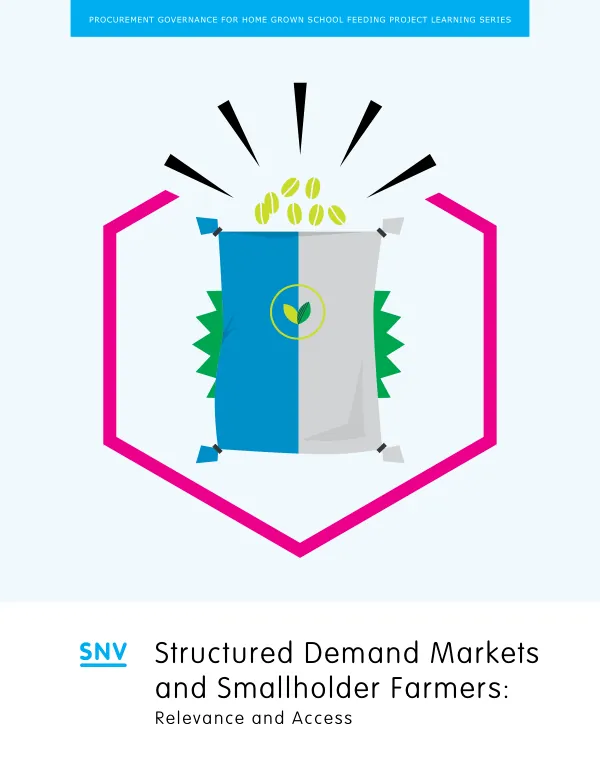
Structured Demand Markets and Smallholder Farmers: Relevance and Access The concept of Structured Demand (SD) markets refers to markets created by public or non-profit entities that have a predictable and reliable demand for food products.
2016 · 23 pages
Sign in to readA free account is required to download.
Abstract
These markets include school feeding, relief programs, and strategic food reserves, among others. Procuring entities such as national and local governments, the World Food Programme, and NGOs can offer a market and an additional source of income for smallholder farmers through inclusive public procurement processes. SD markets can inspire farmer organizations to increase their levels of production and organization in order to meet the demands of SD and other high-value markets. However, for SD markets to be positioned to support social development objectives, three conditions must be met. Firstly, the procurement process must facilitate equal opportunities for smallholder farmers to participate, and procuring officers must be prepared to implement the process in a transparent way. Secondly, smallholder farmers must organize themselves in business-like organizations to create economies of scale and be competitive in SD markets among experienced suppliers. Lastly, the enabling environment must empower smallholder farmers, their organizations, and other rural enterprises to invest in and change agriculture and processing activities. The SNV Procurement Governance for Home Grown School Feeding (PG-HGSF) project, supported by the Bill & Melinda Gates Foundation, aimed to link smallholder farmer Producer Organizations (POs) to SD markets in Ghana, Kenya, and Mali. The project focused on each country's nationally-funded school feeding market and examined actual SD markets in the project countries to determine which markets have the potential to serve as effective boosters of rural development and poverty reduction. An analysis of local SD markets in six counties in Kenya demonstrated the relevance of these markets for smallholder farmers as well as the procurement mechanisms in place that support, or could be adapted to support, smallholder farmer inclusion. The document also presented an analysis of strategic food reserves in the three project countries, including the National Food Buffer Stock Company and grain banks in Ghana, the National Cereals and Produce Board Strategic Grain Reserve in Kenya, and the Office des Produits Agricoles du Mali and cereal banks in Mali. The document concluded with recommendations to support smallholder farmer linkages with SD markets, starting with reflections on the project's collaboration with four strategic food reserves. SNV made recommendations for how governments and development partners can make these SD markets more inclusive to smallholder farmers. The document also presented a summary of complementary interventions to facilitate smallholder farmer access to the SD market of school feeding, based on the experience of PG-HGSF. The Procurement Governance for Home Grown School Feeding (PG-HGSF) project was designed to test and boost the effectiveness of the agricultural mandate of Home Grown School Feeding (HGSF) programmes in Ghana, Kenya, and Mali. The project aimed to determine whether HGSF programmes, with their local and reliable public procurement needs, represent markets with the potential to improve the livelihoods of smallholder farmers. The project used an integrated, participatory piloting approach to answer this question, working on both the supply and demand sides to enhance supply-chain governance and equip farmers and their organizations with the knowledge and skills required to bid on and fulfill school feeding orders. Data on sales to school feeding markets answered the question by 2013: school feeding is an attractive market for smallholder farmers that can trigger some organisational improvements, yet HGSF alone does not necessarily lead to significant improvements in the livelihoods of smallholder farmers. The project's findings suggest that SD markets have the potential to support smallholder farmers, but that further adjustments to procurement processes and enabling environments are necessary to fully realize this potential.
Related documents