NOTRE DAME UNIVERSITY
Student Emotion, Co-occurrence, and Dropout in a MOOC
The study of student emotion in a Massive Open Online Course (MOOC) is a critical area of research, particularly in understanding the relationship between emotions and learning outcomes.
5 pages
Sign in to readA free account is required to download.
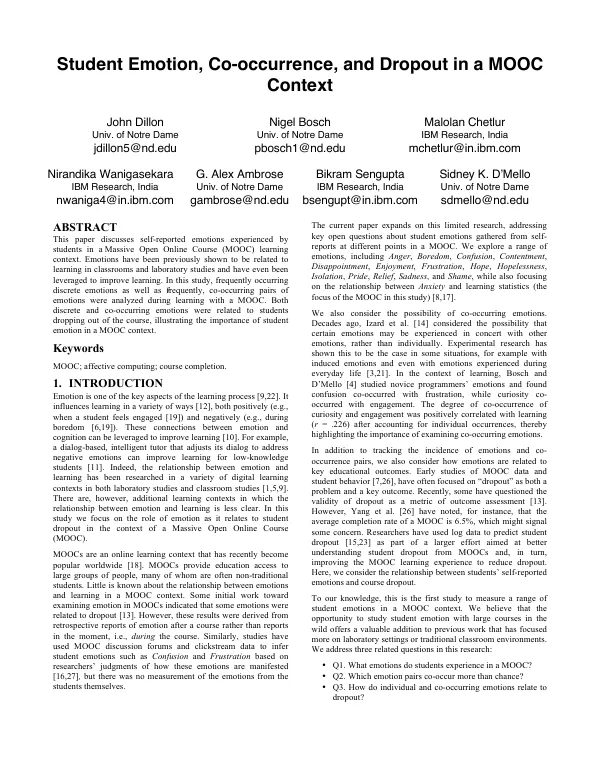
Abstract
The study, conducted by researchers from the University of Notre Dame and IBM Research, India, aimed to investigate the emotions experienced by students in a MOOC setting and their relationship to dropout. The study focused on the "I Heart Stats" MOOC, an introductory Statistics course offered by a university in the Midwestern United States. The course consisted of eight modules, covering topics from levels of measurement to ANOVA. Students were free to complete the modules at their own pace and in any order they desired. The study used a "Pick-Two" list of 15 discrete emotions to measure student affect, including emotions such as Confusion, Boredom, Enjoyment, Pride, Isolation, Hope, and Shame. The study found that Hope and Enjoyment were the most frequently reported emotions, followed by Contentment, Anxiety, and Pride. Shame, Disappointment, Isolation, Anger, and Sadness were reported less frequently. These results differ from previous studies, which focused on short one-on-one interactions during learning with technology. The study also examined the co-occurrence of emotions, finding that certain emotions co-occurred more frequently than chance. For example, Confusion and Frustration co-occurred, while Confusion and Hopelessness co-occurred. These findings suggest that students may experience multiple emotions simultaneously, which can impact their learning outcomes. The study found a significant relationship between individual and co-occurring emotions and dropout. Students who reported higher levels of Anxiety, Frustration, and Hopelessness were more likely to drop out of the course. In contrast, students who reported higher levels of Hope, Enjoyment, and Contentment were less likely to drop out. The study's findings have implications for the design of MOOCs and the development of affective computing systems. By understanding the emotions experienced by students in a MOOC setting, educators and researchers can develop more effective learning strategies and interventions to support student learning and reduce dropout rates. The study's findings also highlight the importance of considering the context in which learning takes place. The study found that the emotions experienced by students in a MOOC context differ from those experienced in other learning contexts. This suggests that educators and researchers need to develop a deeper understanding of the specific needs and challenges of MOOC learners. Overall, the study provides valuable insights into the emotions experienced by students in a MOOC setting and their relationship to learning outcomes. The findings have implications for the development of more effective learning strategies and interventions to support student learning and reduce dropout rates.