USAID DEC
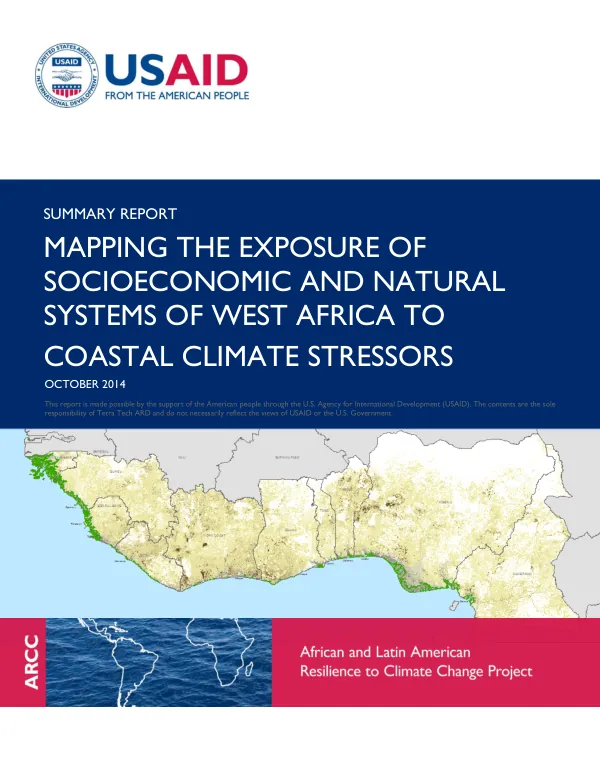
Summary Report: Mapping the Exposure of Socioeconomic and Natural Systems of West Africa to Coastal Climate Stressors
Sign inICAP AT COLUMBIA UNIVERSITY
Summary Report: Mapping the Exposure of Socioeconomic and Natural Systems of West Africa to Coastal Climate Stressors
The coastal countries of West Africa have diverse ethnic, cultural, and historical backgrounds, and represent relatively disparate levels of economic development.
2014 · 19 pages
Sign in to readA free account is required to download.
Abstract
However, they are united by a common pattern of having high levels of economic activity and population concentrations in the coastal zone. A high percentage of West Africa's population is concentrated in coastal cities vulnerable to sea-level rise, with the Intergovernmental Panel on Climate Change (IPCC) estimating that by 2020 more than 50 million people will inhabit the coast from the Niger delta in Nigeria to Ghana's capital city, Accra. The region already faces storm surges with high winds and intense wave action resulting in coastal erosion. This pattern is likely to increase and perhaps intensify as a result of higher sea surface temperatures. The focus of this study is on the populations and economic and natural systems that are exposed to these combined seaward hazards, as well as to flooding of major rivers draining into the Atlantic. The climate vulnerability mapping study covers the Guinea Current countries, extending from Guinea-Bissau in the northwest to Cameroon in the southeast. The combined population of the 10 countries in the region is 265 million people. Seven percent of that population, or 19 million people, live in the low elevation coastal zone (LECZ) of less than 10m above mean sea level. Almost half of the population, or 124 million people, live within 200 km of the coast. The coastal fringe from Côte d'Ivoire to Nigeria is a relatively low-lying region of rapid population growth and intense economic development, making it particularly vulnerable to future surge and SLR impacts. The study uses a combination of geographic information systems (GIS) and socioeconomic data to identify patterns of exposure, sensitivity, and adaptive capacity that contribute to specific constellations of vulnerability. The focus is on exposure, though patterns of social vulnerability and economic activity are also presented, which could represent different levels of sensitivity and adaptive capacity. The study aims to provide a comprehensive understanding of the likely exposure of different systems to seaward stressors among the Guinea Current countries. The study's methodology involves the use of GIS to analyze the spatial distribution of population, economic activity, and natural systems in the region. Socioeconomic data are used to identify patterns of social vulnerability and economic activity that could represent different levels of sensitivity and adaptive capacity. The study also uses climate change projections to estimate the potential impacts of sea-level rise and storm surges on the region. The study's results show that the coastal countries of West Africa are highly vulnerable to sea-level rise and storm surges. The low elevation coastal zone (LECZ) is particularly vulnerable, with 19 million people living in areas less than 10m above mean sea level. The study also identifies areas of high social vulnerability and economic activity, which could represent different levels of sensitivity and adaptive capacity. The study's conclusions highlight the need for urgent action to address the vulnerability of the coastal countries of West Africa to sea-level rise and storm surges. The study recommends the development of adaptation strategies that take into account the specific needs and capacities of different communities and ecosystems. The study also emphasizes the importance of international cooperation and support to help the region adapt to the impacts of climate change. The study's limitations include the use of simplified climate change projections and the lack of detailed socioeconomic data for some areas. However, the study provides a comprehensive understanding of the likely exposure of different systems to seaward stressors among the Guinea Current countries. The study's results can inform the development of adaptation strategies and policies to help the region adapt to the impacts of climate change.