DIMAGI, INC.
Supply Chain Management Newsletter, Quarter 4, 2012
However, this document focuses on supply chain management in low- and middle-income countries, particularly in Africa and Asia.
2012 · 12 pages
Sign in to readA free account is required to download.
Abstract
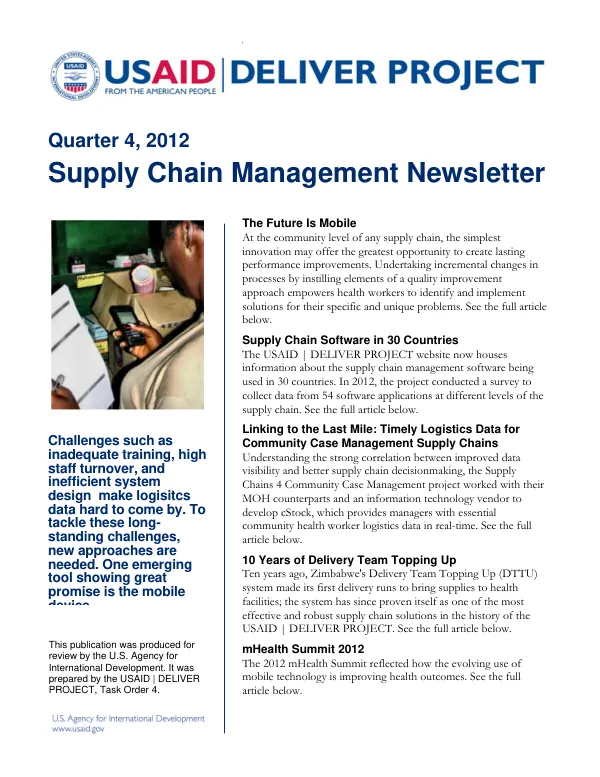
The main purpose of this document is to highlight the importance of mobile devices in improving supply chain data visibility and decision-making. Supply chains across the globe are taking advantage of the ubiquity of mobile devices, which can be used to track the flow of commodities, report stockouts, and map availability. Mobile supply chain solutions leverage the familiarity that supply chain workers already have with these devices, taking simple technology, such as SMS, and using it to open up visibility of the supply chain even at the last mile. Dynamic websites with near real-time supply information provide much-needed data to decision-makers and supervisors upstream. One emerging tool showing great promise is the mobile device, which is widely used even in areas that lack fixed telephone lines or consistent electricity. In sub-Saharan Africa, mobile phone subscriber penetration is expected to surpass 80 percent this quarter, with an average annual growth rate of 44 percent since 2000. Similar mobile adoption can be found consistently across low- and middle-income countries throughout Asia and South America. The USAID | DELIVER PROJECT has been working with various countries to implement mobile supply chain solutions. In Ghana, the Early Warning System (EWS) began in July 2011 and has since been expanded to approximately 200 additional facilities. Using recent advances in mobile technology, the system enhances logistics data reporting, visibility, and utilization to improve the supply chain. With EWS, health facility staff use mobile phones to report stock levels of 27 tracer commodities via SMS, and data is processed and immediately made available to all relevant stakeholders. In Guatemala, the USAID | DELIVER PROJECT initiated ILMOVIL, a pilot project with the Health District of San Marcos, to improve data-driven decision-making. The pilot uses simple mobile phone-based technology that allows each health post to send weekly SMS messages containing essential logistics data for 12 products across four programs. The incoming data is loaded into an Excel dashboard that produces standard supply chain indicators, such as average months of consumption and months of stock. In India, John Snow, Inc. partnered with the Micronutrient Initiative and software consulting company Dimagi to conduct an assessment of the micronutrient supply chain in Gujarat. The group developed a concept and project plan for creating a mobile supply chain information system to provide real-time stock status information for select commodities, improve the timeliness and accuracy of paper-based reporting, and improve tracking of treatment outcomes for diarrhea in children under the age of five. In Liberia, mobile phones are being used to reduce food insecurity and chronic malnutrition of vulnerable women and children. The USAID/Food For Peace Title II-funded Liberian Agriculture project is using mobile phones to register food aid beneficiaries and track their status. This project aims to improve the efficiency and effectiveness of food aid distribution and reduce the risk of stockouts and overstocking. Overall, mobile devices are playing a crucial role in improving supply chain data visibility and decision-making in low- and middle-income countries. By leveraging the ubiquity of mobile devices, supply chain managers can gain real-time insights into stock levels, consumption rates, and other key metrics, enabling them to make more informed decisions and improve the efficiency and effectiveness of their supply chains.