NATIONAL AGRICULTURE INSTITUTE
Supply Response of Export Crops in Zambia: The Case of Coffee
High and sustainable export growth, driven by agricultural product, is critical for Zambia to reduce poverty and economic development.
2012 · 4 pages
Sign in to readA free account is required to download.
Abstract
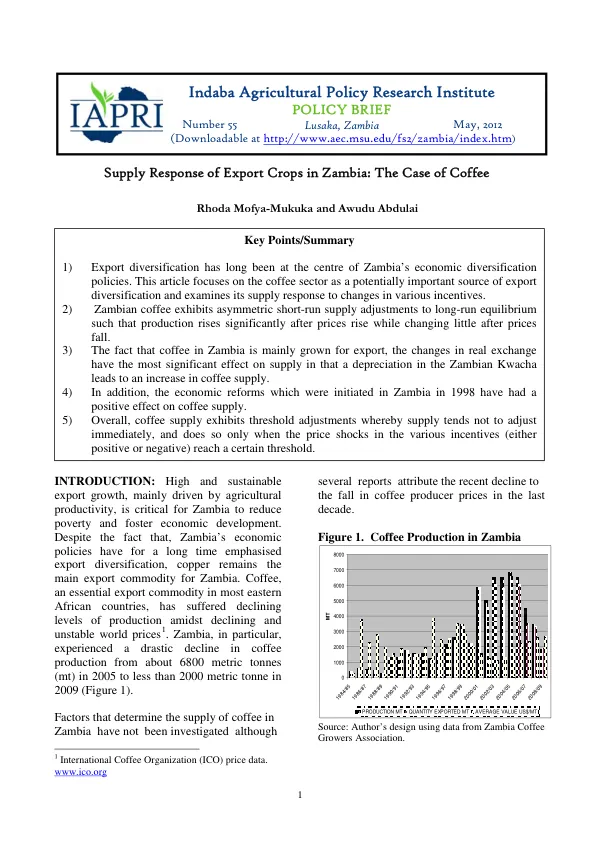
Despite emphasizing export diversification, Zambia's economic policies have long been centered on copper as the main export commodity. Coffee, a significant export commodity in eastern African countries, has experienced declining production levels due to unstable and declining prices. Zambia's coffee production declined drastically from 6800 metric tonnes in 2005 to less than 2000 metric tonnes in 2009. The factors determining coffee supply in Zambia have not been thoroughly investigated, although several reports attribute the recent decline to the decline in coffee producer prices over the last decade. Coffee production in Zambia has been declining, with a significant drop in production from 6800 metric tonnes in 2005 to less than 2000 metric tonnes in 2009. Export diversification has been a central aspect of Zambia's economic diversification policies. This article focuses on the coffee sector as a potential source of export diversification and examines its supply response to changes in various incentives. The study aims to identify key variables that are important in determining agricultural commodity supply, which is essential for policy planning. The study employs an asymmetric auto-regression model to examine the supply response of coffee to various incentives, including coffee prices, maize prices, the real exchange rate, and economic reforms initiated in the 1998 liberalization period. The study compares the results of two models, one that ignores aspects of asymmetric response and another that takes into account the possibility of coffee supply responding asymmetrically to changes in incentives. The results of the first stage regression show that the long-run relationships between coffee supply and the explanatory variables are established. The results of the second stage regression show that the residuals from the regression results in the first stage are stationary. The results of the first stage regression are as follows: RF = 795, RER = 331, m = 010, c = 0421, and t = 154. The variables are described in table 1. The equation above shows that the real exchange rate is the most significant variable in determining coffee supply. A positive coefficient of the exchange rate means that when the Zambian Kwacha weakens against the dollar, coffee supply increases. A strong currency makes the commodity less competitive, hence unattractive for farmers to plant more or invest more in the growing trees. A one-unit depreciation of the Kwacha leads to a 0.33 percent increase in coffee supply in the long run. The results show that economic reforms, which occurred in 1998, have had a positive and statistically significant impact on coffee production. The coefficient is positive, indicating that coffee production increased following the economic reforms. By contrast, the effect of local coffee prices on coffee production in Zambia in the long run is negative and not significant from this model. Similarly, the price of maize, the competitive crop with coffee, has no significant impact on coffee production. The results do not differentiate between the effects of positive and negative shocks on supply response. Due to the possibility of asymmetric supply movement, a threshold log relationship between coffee supply and the various incentives was examined using a TAR model. The results show that there is a long-run relationship between coffee supply and the incentives. Adjustment towards this long-run relationship depends on whether a deviation is above a threshold of $0.23 or below. The results of the TAR model show that positive shocks and negative shocks have different impacts on coffee supply. For changes in coffee prices, while the Engle and Granger model showed no significant impact of coffee prices on coffee supply, the asymmetric model shows an increase of 0.26 percent in coffee supply when the price gets above a threshold of $0.23 per pound. Below this threshold, there is no significant impact on coffee supply in the country. However, just like the results from the first model, changes in maize prices have no significant effect on coffee supply in the long run, whether the system is above or below the threshold. The study's findings have significant implications for policy planning. The results suggest that the real exchange rate is the most significant variable in determining coffee supply. A depreciation in the Kwacha leads to an increase in coffee supply, indicating that coffee production is sensitive to changes in the exchange rate. The study's findings also suggest that economic reforms have had a positive impact on coffee production, indicating that the liberalization period has had a positive effect on the coffee sector. The study's findings also suggest that coffee supply exhibits threshold adjustments, where supply tends not to adjust immediately and only does so when the price shocks in the various incentives reach a certain threshold. The study's findings have significant implications for policy planning, indicating that the government should focus on policies that promote a weak currency and economic reforms to increase coffee production.