USAID DEC
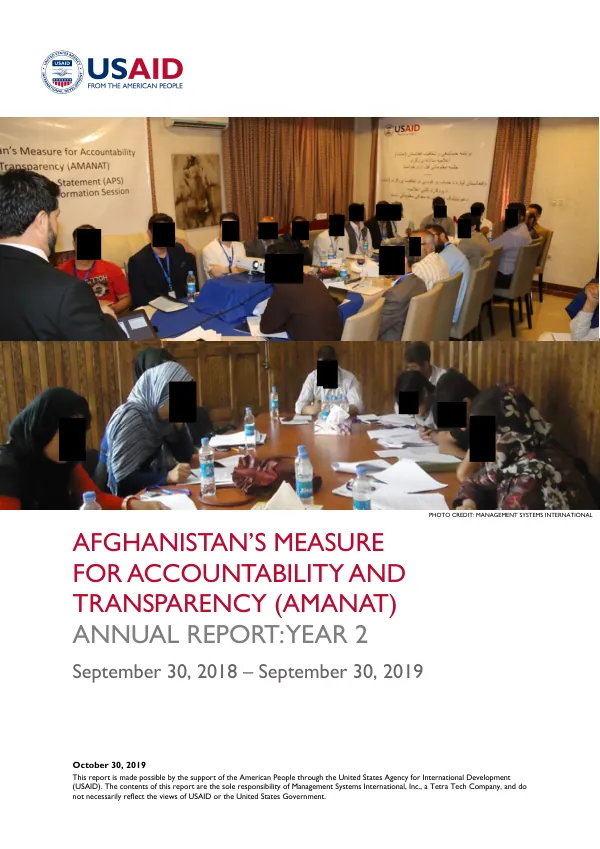
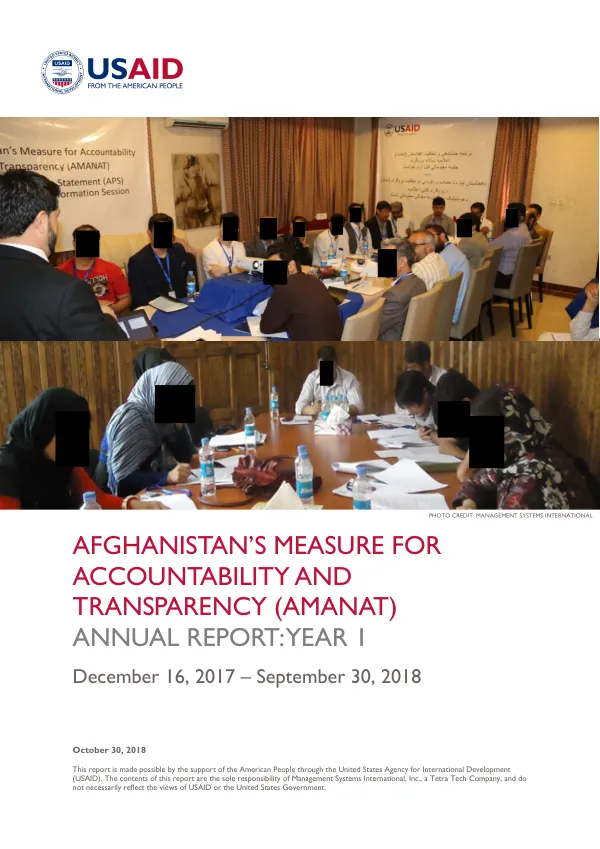
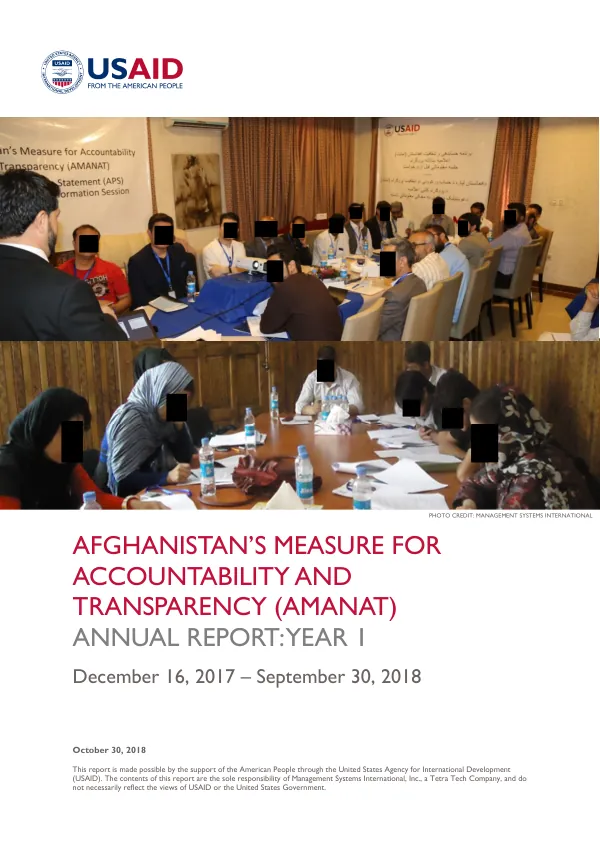
Afghanistan’s Measure for Accountability and Transparency (AMANAT) Annual Report: Year 1
Sign inGOVERNMENT OF THE ISLAMIC REPUBLIC OF AFGHANISTAN
Afghanistan’s Measure for Accountability and Transparency (AMANAT) Annual Report: Year 1
Afghanistan's Measure for Accountability and Transparency (AMANAT) project is a five-year anti-corruption initiative designed to support the Afghan government's efforts to reduce and prevent corruption in government public services.
2018 · 31 pages
Sign in to readA free account is required to download.
Abstract
The project engages with both government and nongovernmental organizations to strengthen transparency and accountability mechanisms and build civil society's ability to advocate for reform. The project conducts activities in two components. Working with government beneficiaries, Component 1 seeks to enhance the capacity of government institutions to identify vulnerabilities to corruption in their processes and functions, and to strengthen their capacity to implement anti-corruption reforms. Working with civil society beneficiaries, Component 1 also seeks to build the ability of civil society to assess and improve government anti-corruption efforts. Component 2 is a special programming mechanism by which USAID will be able to issue task orders to the AMANAT project under an IDIQ mechanism to address tasks that are not covered in Component 1. The project's objectives are to improve the performance, legitimacy, and capacity of the Government of the Islamic Republic of Afghanistan (GIRoA) in fighting corruption, and to reduce and prevent corruption in government public services and functions. To accomplish this, AMANAT works at the national and subnational level to strengthen Afghan government institutions and civil society organizations (CSOs) to identify vulnerabilities to corruption in the delivery of public services and develop corresponding recommendations to address these vulnerabilities. The project also supports select Afghan government institutions with technical assistance to plan for and implement procedural reforms based on those recommendations. During the first year of project operations, major accomplishments include conducting a rapid political economy analysis (PEA) of corruption, which identified reforms that are likely to have the highest impact on Afghan government revenues and public service delivery. The project also designed and began to implement a new PEA study requested by USAID, commenced work with the Afghanistan Independent Joint Anti-Corruption Monitoring and Evaluation Committee (MEC), and released the first year's Annual Program Statement (APS) calling for CSO grant proposals. Additionally, the project conducted five grants workshops, evaluated ten full grant proposals, and prepared to request USAID vetting and approval for eight proposals in Year 2. The project also released a call for proposals (RFP) for US small businesses to provide Business Process Redesign capacity building training and technical support services for the project in Year 2, developed a CSO database of national and subnational CSOs that work on anti-corruption, accountability, and transparency issues, and established working relationships with key umbrella CSOs in Afghanistan to support CSO capacity building on anti-corruption issues. Furthermore, the project identified a preliminary group of provincial CSOs that AMANAT could partner with on anti-corruption, transparency, and accountability issues, and met with key GIRoA institutions who conduct anti-corruption functions and oversight responsibilities. The project's approach is to focus on willing beneficiaries and apply innovative and tested techniques that facilitate stakeholder buy-in and commitment, follow-through, progress, sustainability, and learning and adaptation to reduce and prevent corruption. Once reforms are implemented, functions and processes will be monitored by the project to ensure that they are sustainable before turning to additional institutions and services. The project's activities are designed to be realistic and achievable, with the goal of making progress and building momentum towards reducing and preventing corruption in government public services and functions.