FINTRAC
Supporting National Strategy to Combat Coffee Rust
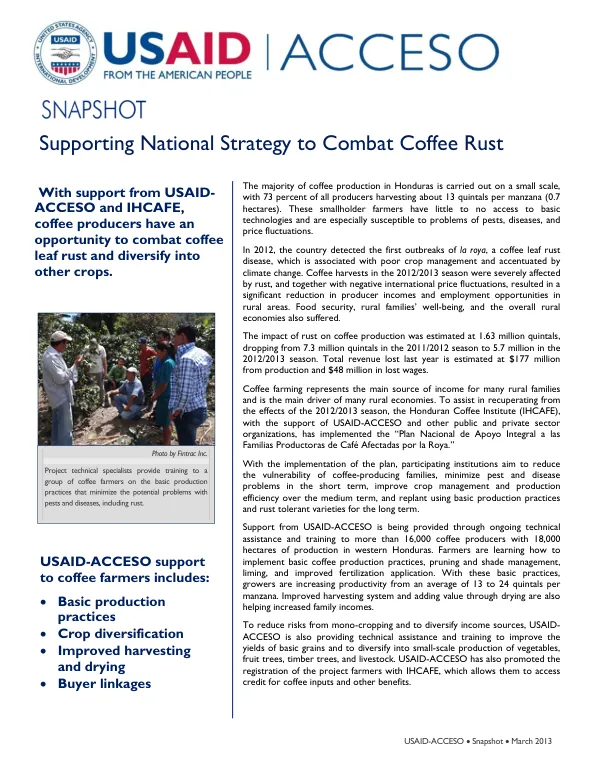
The Honduran Coffee Institute, with support from USAID-ACCESO and other public and private sector organizations, has implemented the "Plan Nacional de Apoyo Integral a las Familias Productoras de Café Afectadas por la Roya" to assist coffee-producing families affected by coffee leaf rust.
2013 · 1 pages
Sign in to readA free account is required to download.
Abstract
The plan aims to reduce the vulnerability of coffee-producing families, minimize pest and disease problems in the short term, improve crop management and production efficiency over the medium term, and replant using basic production practices and rust-tolerant varieties for the long term. Coffee farming represents the main source of income for many rural families and is the main driver of many rural economies. The majority of coffee production in Honduras is carried out on a small scale, with 73 percent of all producers harvesting about 13 quintals per manzana (0.7 hectares). These smallholder farmers have little to no access to basic technologies and are especially susceptible to problems of pests, diseases, and price fluctuations. In 2012, the country detected the first outbreaks of la roya, a coffee leaf rust disease, which is associated with poor crop management and accentuated by climate change. The impact of rust on coffee production was estimated at 1.63 million quintals, dropping from 7.3 million quintals in the 2011/2012 season to 5.7 million in the 2012/2013 season. Total revenue lost last year is estimated at $177 million from production and $48 million in lost wages. To assist in recuperating from the effects of the 2012/2013 season, USAID-ACCESO is providing ongoing technical assistance and training to more than 16,000 coffee producers with 18,000 hectares of production in western Honduras. Farmers are learning how to implement basic coffee production practices, pruning and shade management, liming, and improved fertilization application. With these basic practices, growers are increasing productivity from an average of 13 to 24 quintals per manzana. Improved harvesting systems and adding value through drying are also helping to increase family incomes. USAID-ACCESO is also providing technical assistance and training to improve the yields of basic grains and to diversify into small-scale production of vegetables, fruit trees, timber trees, and livestock. The registration of project farmers with the Honduran Coffee Institute allows them to access credit for coffee inputs and other benefits. This support is helping to reduce the vulnerability of coffee-producing families and minimize pest and disease problems in the short term, improve crop management and production efficiency over the medium term, and replant using basic production practices and rust-tolerant varieties for the long term.
Related documents