USAID DEC
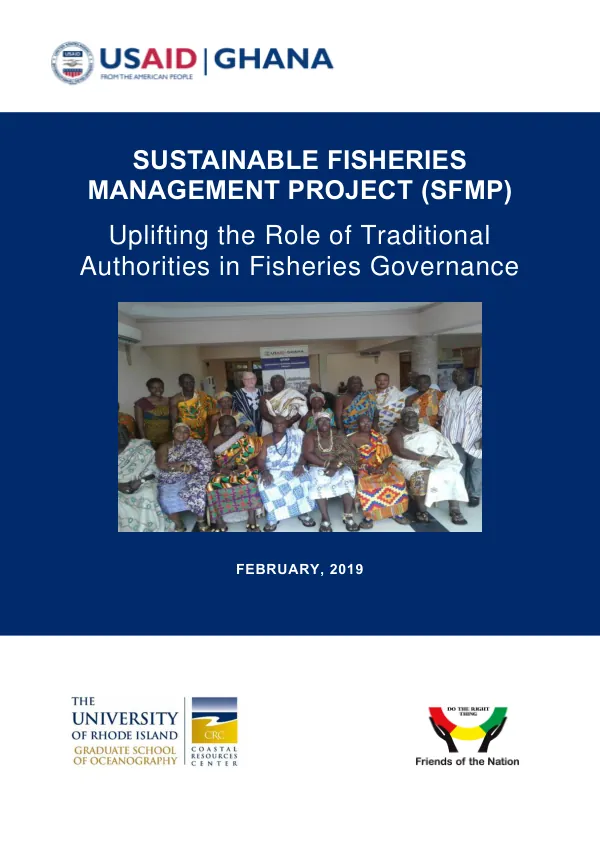
Sustainable Fisheries Management Project (SFMP) Uplifting the Role of Traditional Authorities in Fisheries Governance
Sign inCOASTAL RESOURCES CENTER
Sustainable Fisheries Management Project (SFMP) Uplifting the Role of Traditional Authorities in Fisheries Governance
The Sustainable Fisheries Management Project (SFMP) aimed to uplift the role of traditional authorities in fisheries governance in Ghana.
2019 · 10 pages
Sign in to readA free account is required to download.
Abstract
The project, implemented by the Coastal Resources Center and Friends of the Nation, sought to find a balance between traditional systems and the central fisheries management system led by government. Traditional leaders, including paramount chiefs, queen mothers, and headmen, play a crucial role in governance in local Ghanaian fishing communities. Historically, traditional systems were effective in promoting voluntary compliance of customary laws and by-laws in local fishing communities. The traditional leadership, led by the paramount chief, delegated authority to the chief fisherman to manage fishing activities at the landing sites. The culture and traditional practices of communities influenced fishery practices, with the observance of weekly traditional fishing holidays being effectively supervised and enforced by the chief fishermen. However, the central government's involvement in fishing, aimed at promoting sustainability, has contributed to eroding the powers and involvement of traditional systems in fisheries governance. The government's engagement in fisheries development has sidelined the chief fishermen and traditional leaders, including chiefs and queen mothers. This has led to a decline in the respect and recognition of traditional leaders' roles in fisheries governance. The SFMP supported traditional leaders from coastal areas of Ghana to review their roles in the current fisheries governance and promote best fisheries management practices. As a result, traditional leaders have shown increasing interest in participating in collaborative fisheries management initiatives in Ghana. The project's goal is to find a balance between traditional systems and the central fisheries management system, addressing the weak fisheries governance in Ghana. The project's implementation strategy focused on building the capacity of traditional leaders to participate in fisheries governance. This included training and workshops to enhance their understanding of fisheries management practices and their roles in promoting sustainable fishing. The project also aimed to strengthen the relationship between traditional leaders and government agencies responsible for fisheries management. Progress and results from the project indicate that traditional leaders have shown increasing interest in participating in collaborative fisheries management initiatives. The project has also contributed to the development of a framework for integrating traditional systems into the central fisheries management system. This framework aims to promote a balance between traditional and modern approaches to fisheries management. Lessons learned from the project highlight the importance of involving traditional leaders in fisheries governance. The project has demonstrated that traditional systems can play a crucial role in promoting sustainable fishing practices and ensuring the long-term sustainability of fisheries resources. The project's success has also underscored the need for a collaborative approach to fisheries management, involving both traditional and modern systems. The project's application has been to promote a more inclusive and participatory approach to fisheries governance in Ghana. The project has contributed to the development of a more effective and sustainable fisheries management system, one that balances traditional and modern approaches. The project's next steps for Ghana include scaling up the project's activities to other coastal communities and continuing to build the capacity of traditional leaders to participate in fisheries governance. The project's success has also highlighted the need for continued support for traditional leaders and their roles in fisheries governance. The project has demonstrated that traditional systems can play a crucial role in promoting sustainable fishing practices and ensuring the long-term sustainability of fisheries resources. The project's findings and recommendations have implications for fisheries management in Ghana and beyond, highlighting the importance of involving traditional leaders in fisheries governance.
Related documents