USAID DEC
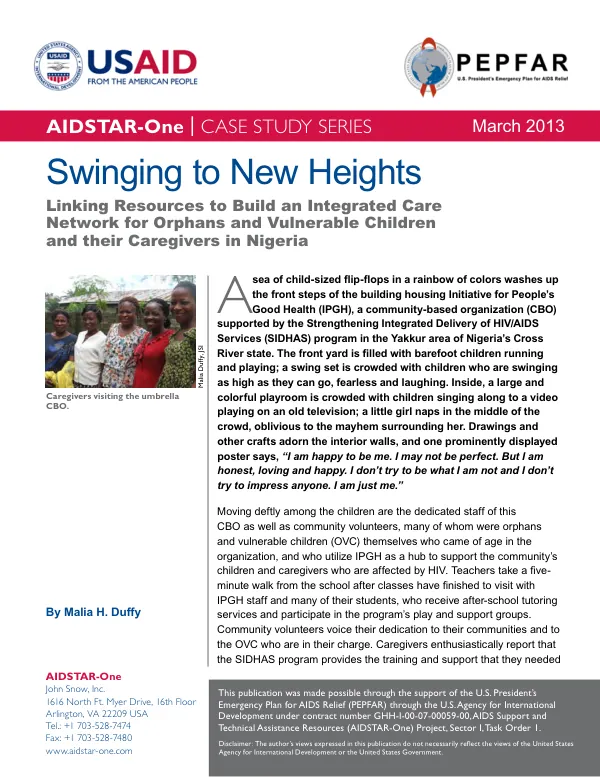
Swinging to New Heights: Linking Resources to Build an Integrated Care Network for Orphans and Vulnerable Children and their Caregivers in Nigeria
Sign inFHI 360
Swinging to New Heights: Linking Resources to Build an Integrated Care Network for Orphans and Vulnerable Children and their Caregivers in Nigeria
The SIDHAS program in Nigeria aims to improve the well-being of orphans and vulnerable children (OVC) in selected states and local government areas (LGAs).
2013 · 17 pages
Sign in to readA free account is required to download.
Abstract
The program seeks to establish a sustainable coordination mechanism among stakeholders at all levels, operationalize OVC as a service provision strategy at the LGA level, build the capacity of service providers for efficient programming, implement needs-based interventions for OVC and service providers in the community, and develop and implement a monitoring and evaluation (M&E) plan in conformity with the national framework to guide policy and program decisions. The SIDHAS program is working to bridge gaps in service provision for OVC and their caregivers, particularly in rural areas, among children under age 5, and among youth over age 17. The program is also addressing the issue of service location, where areas of high HIV prevalence have insufficient programs for OVC, while areas of low prevalence have an over-abundance of programs. SIDHAS builds upon the notable achievements made by the Global HIV/AIDS Initiative Nigeria (GHAIN) program, which was funded by the U.S. President's Emergency Plan for AIDS Relief (PEPFAR) through USAID. The SIDHAS integrated community-based program is based on the HIV/AIDS, sexual and reproductive health (SRH), and tuberculosis (TB) (HAST) model, developed during the GHAIN program. The program identifies existing community resources that respond to HIV, SRH, and TB among OVC and their caregivers. The LGA serves to coordinate the integrated approach and creates linkages between community activities and health facilities by building a strong network of referrals and coordinated services. Implementation of the SIDHAS program began with a focus on building the capacity of the State Implementation Team (SIT) and the LGA, as well as the capacity of hospital and public health centers (PHC). Over time, SIDHAS has transitioned this model such that the LGA and SIT are now in the position to continually build the capacity of local organizations and service providers. The program has established a comprehensive and integrated program that strengthens and builds services for OVC in local government areas (LGAs) in Cross River and Kano states. The SIDHAS program covers a catchment area of approximately 597,000 in Kano state and 196,000 in Cross River state. The program aims to assist the government of Nigeria to provide antiretroviral therapy (ART) to 252,000 men, women, and children, provide HIV testing and counseling (HTC) to 1.7 million women to prevent mother-to-child transmission, and for 41,200 pregnant women to complete ART. The program also provides a comprehensive and integrated program that strengthens and builds services for OVC in local government areas (LGAs) in Cross River and Kano states. The SIDHAS program has demonstrated that leveraging existing capacity and building strong linkages between sectors can improve the efficiency and effectiveness of HIV programs and create a system of holistic services to support affected communities. The program has shown that it is possible to reach the needs of all OVC in Nigeria, particularly in rural areas, among children under age 5, and among youth over age 17. The SIDHAS program is a model for sustainable and integrated community-based programs that can be replicated in other countries.