HEALTH PARTNERS INTERNATIONAL
TB CARE Annual Work Plan and Budget
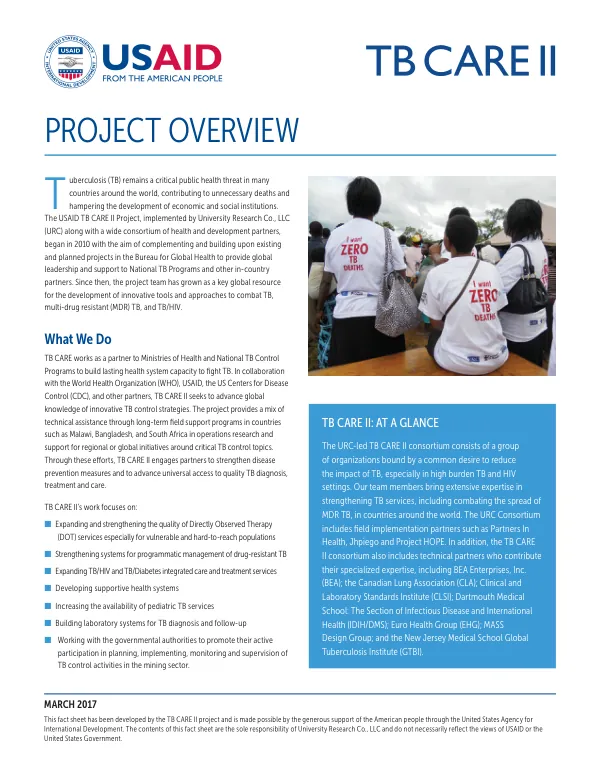
The TB CARE II Project in Malawi is a five-year cooperative agreement between the United States Agency for International Development (USAID) and University Research Co., LLC (URC).
2012 · 15 pages
Sign in to readA free account is required to download.
Abstract
The project aims to accelerate the implementation of programs for TB DOTS, TB/HIV, and Programmatic Management of Drug-Resistant TB (PMDT) in high-burden countries. The project has received support from various organizations, including the Global Fund to Fight AIDS, TB, and Malaria (GFATM), the Ministry of Health (MOH), and the district communities served by the project. The project's main focus is on improving case detection and treatment success through DOTS expansion and strengthening, scaling up access to TB diagnosis and treatment, especially in women and vulnerable populations, and integrating TB/HIV services at all levels. The project has also prioritized the improvement of TB/HIV integration, particularly at the health facility level, and the provision of high-quality DOTS services through a wider range of service delivery points. TB CARE II has implemented its activities in 12 target districts in Malawi, including Machinga, Mangochi, Mulanje, Neno, Ntchue, Phalombe, Nsanje, Nkhotakota, Mzimba, Balaka, Zomba, and Chikwawa. The project has also conducted sensitization and strategic planning meetings with the zonal and district TB partners, and has established a Project Management Team to oversee the implementation of the project. The project has achieved several notable results, including the completion of baseline assessments in 6 new target districts and the development of district-specific work plans. The project has also strengthened the laboratory network and improved the Central Reference Laboratory (CRL) capacity, supported the nascent drug-resistant TB treatment program, and piloted new diagnostics. TB CARE II has also focused on improving the programmatic integration of TB/HIV services, particularly at the health facility level, and has provided high-quality DOTS services through a wider range of service delivery points. The project has also strengthened community-based mechanisms for TB case detection, contact tracing, and adherence, and has ensured a functioning national program for MDR-TB prevention and treatment. The project's major project outputs include an improved environment for TB case detection in TB CARE II target districts, the decentralization of TB registration and treatment initiation to community hospital and health center levels, the strengthening of community-based mechanisms for TB case detection, contact tracing, and adherence, and the provision of "One-stop" services for HIV and TB co-infected patients. The project's major accomplishments include the improvement of case detection through DOTS expansion and strengthening, the enhancement of TB/HIV programmatic integration, the improvement of the programmatic management of drug-resistant TB, and the leveraging of TB control interventions to strengthen the overall health system. The project has also strengthened community-based mechanisms for TB case detection, contact tracing, and adherence, and has ensured a functioning national program for MDR-TB prevention and treatment. The project's major project outputs include an improved environment for TB case detection in TB CARE II target districts, the decentralization of TB registration and treatment initiation to community hospital and health center levels, and the strengthening of community-based mechanisms for TB case detection, contact tracing, and adherence. TB CARE II has implemented its activities in 12 target districts in Malawi, including Machinga, Mangochi, Mulanje, Neno, Neno, Ntchue, Phalombe, Nsanje, Nkhotakota, Mzimba, Balaka, Zomba, and Chik
Related documents