MINISTRY OF HEALTH
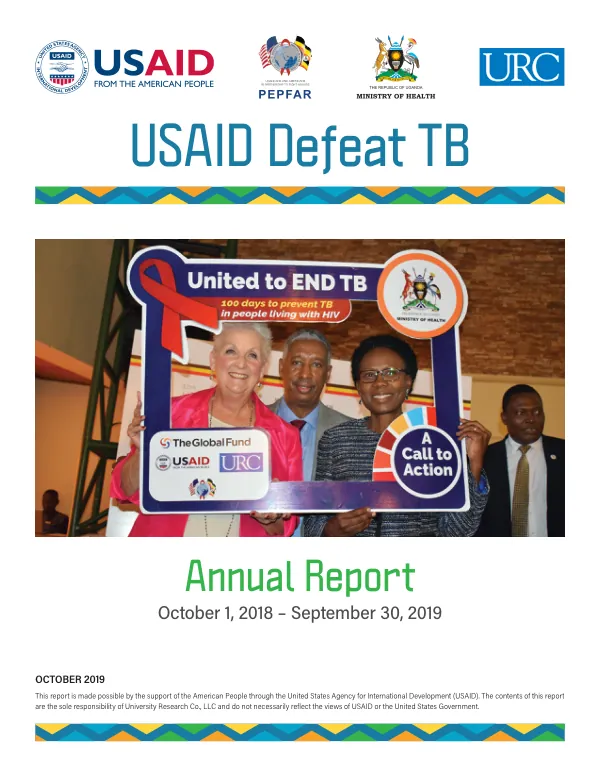
Annual Report: USAID Defeat TB Activity in Uganda
The USAID Defeat Tuberculosis (TB) Activity is a five-year project that aims to increase TB case detection and treatment success to 90% of all cases to end the TB epidemic in Uganda.
2019 · 78 pages
Sign in to readA free account is required to download.
Abstract
The project realizes its achievements through health systems strengthening at national, sub-national, and health facility levels with a focus on improving health worker competencies, including quality improvement (QI), community systems, diagnostics, logistics, leadership, data quality and use. Defeat TB provides technical assistance (TA) to the National TB and Leprosy Program (NTLP) and direct service delivery (DSD) support to focus districts of Kampala, Wakiso, and Mukono, seven DR-TB sites in Uganda in the CDC-funded region. The project also provides TA to 10 DR-TB sites in close collaboration with Regional USAID implementation mechanisms. During the period of October 1, 2018 to September 30, 2019, USAID Defeat TB maintained focus on supporting high patient volume sites to optimize screening and TB case detection using continuous quality improvement coaching, mentorship and peer learning approaches to improve performance, contact investigation, targeted screening activities for populations at high risk for TB. Additional focus was put on follow-up interventions to improve retention of patients on TB treatment. At national level, the project scaled up lessons learnt from activities conducted in the focus districts and enhanced NTLP's resource mobilization and coordination roles. The TB case detection rates for Kampala, Wakiso, and Mukono districts increased from 61% (9,962 incident TB cases) during the baseline year of October 2016 to September 2017 to 65% (10,723 cases) and 74% (12,171 cases) in performance year 1 (PY1) and PY2, respectively. Wakiso district reported the highest improvement in the TB case detection rate from 54% (2,116 cases) at baseline to 83% (3,292 cases) in PY2. A total of 3,136 (26%) of the incident TB cases notified were from community referrals from contact tracing and targeted TB screening outreaches, with support from community linkage facilitators. The project also provided training to health care workers on TB diagnosis, treatment, and management, resulting in improved treatment success rates. The project's interventions and achievements are expected to contribute to the reduction of TB cases and deaths in Uganda. The project's focus on improving health worker competencies, community systems, diagnostics, logistics, leadership, data quality and use has led to improved TB case detection and treatment success rates. The project's technical assistance to the NTLP and direct service delivery support to focus districts have also contributed to the project's achievements. The project's lessons learnt and best practices are expected to be scaled up to other districts and regions in Uganda. The project's achievements and lessons learnt are expected to contribute to the reduction of TB cases and deaths in Uganda. The project's focus on improving health worker competencies, community systems, diagnostics, logistics, leadership, data quality and use has led to improved TB case detection and treatment success rates. The project's technical assistance to the NTLP and direct service delivery support to focus districts have also contributed to the project's achievements.