KNCV TUBERCULOSIS FOUNDATION
TB CARE Annual Work Plan and Budget
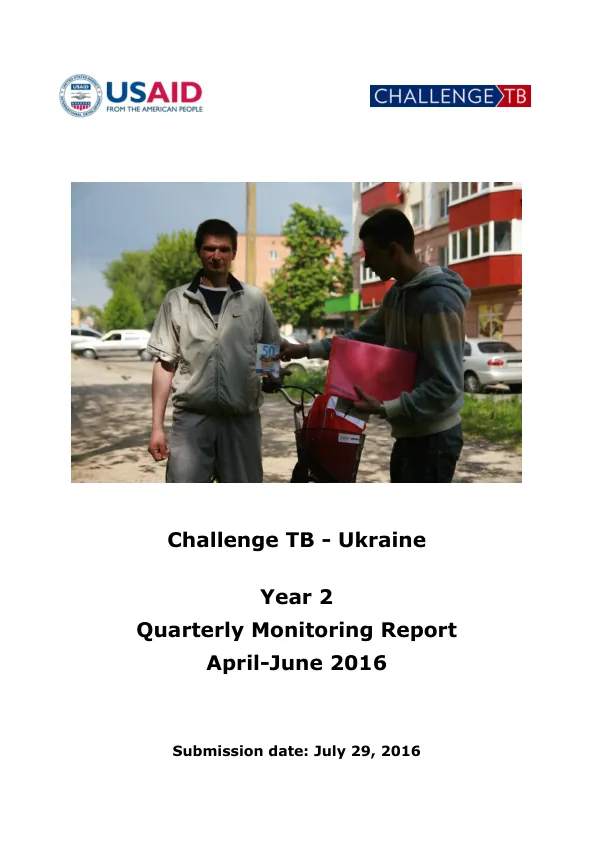
The Challenge TB project in Ukraine continued to expand and improve a model for patient-centered approach to multidrug-resistant tuberculosis (MDR-TB) care during the third quarter of Year 2 (April 1–June 30, 2016).
2016 · 26 pages
Sign in to readA free account is required to download.
Abstract
The project collaborated with various partners, including the Ukrainian Center for Socially Dangerous Disease Control of the Ministry of Health of Ukraine (UCDC), the National Research Institute on TB and Lung Diseases, and the National Red Cross Society, to implement the Year 2 work plan. The project extended patient-centered approach activities to a new project partner oblast (Kyivska oblast) and developed recommendations on improving the process of active case-finding and management of TB among close contacts. A draft operational research (OR) protocol for introducing new drugs and shortened treatment regimens for MDR-TB treatment was also developed, with the aim of achieving improved MDR-TB treatment success rates in project oblasts. To ensure timely detection, diagnosis, and treatment initiation for potentially missed TB cases, the CTB project conducted a workshop in Poltava with all involved parties to discuss a developed draft algorithm of contact investigation and the roles of TB services, SES, and primary health care level in TB contact investigation and management. The project also finalized the set of recommendations to be suggested to the national contact investigation strategy. The draft clinical guidelines for side-effects management for TB and DR-TB patients were finalized during the previous quarter and submitted to the UCDC and State Expert Center for further approval by the Ministry of Health's (MOH) order to implement country-wide. A webinar on guideline principles was conducted on June 30, 2016, in collaboration with the National Research Institute on TB and Lung Diseases, with over 120 participants from 59 entry points from 21 oblasts in Ukraine. The CTB project continued to implement the patient-centered approach and provided social, psychological, and other support to 253 MDR-TB patients to ensure their treatment completion at the ambulatory phase. Three NGOs in Poltavska and Mykolaivska oblasts provided 170 MDR/XDR-TB patients with medical, nutrition, transport, legal, and other support as needed. Red Cross visiting nurses continued to provide ongoing medical and social support to prevent defaults and ensure Directly Observed Treatment (DOT) at the ambulatory phase of treatment. Administrative challenges, including rotations of the MOH Deputy Minister in charge of HIV and TB and absence of the Minister of Health, led to delays in the approval of national-level documents, including the protocol on side-effect management developed by the project. Technical challenges, including high levels of resistance to first- and second-line drugs among Rif TB cases, were also identified. The project proposed to adjust the shortened regimens recommended by WHO for Ukrainian patients and requested review of suggested regimens from WHO and Green Light Committee. The project continued to engage local partners in implementing the patient-centered strategy and creating multi-disciplinary teams to address structural barriers to treatment adherence. Monitoring visits were conducted to provide technical assistance and supportive supervision to sub-awardees and to interview MDR-TB patients, who provided positive feedback on the role of social and psychological support in their willingness to complete treatment.
Related documents