USAID DEC
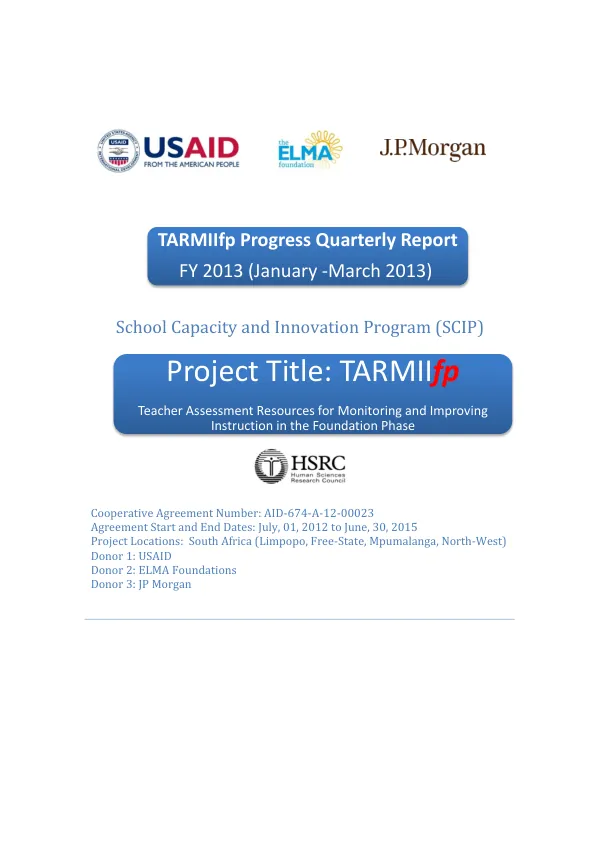
Teacher Assessment Resources for Monitoring and Improving Instruction in the Foundation Phase TARMII_fp
Sign inUSAID
Teacher Assessment Resources for Monitoring and Improving Instruction in the Foundation Phase TARMII_fp
The Teacher Assessment Resources for Monitoring and Improving Instruction in the Foundation Phase (TARMII-fp) project is a collaborative effort between the Human Sciences Research Council (HSRC) and various stakeholders in South Africa.
2012 · 10 pages
Sign in to readA free account is required to download.
Abstract
The project aims to improve teaching and assessment practices through the use of a fully developed TARMII-fp software with literacy Home Language assessment items for grades 1, 2, and 3. Implementation of the project began in 2012, with funding from USAID, ELMA Foundations, and JP Morgan. The project focuses on four provinces in South Africa: Limpopo, Free State, Mpumalanga, and North-West. The project's objectives include assessing the impact of the TARMII-fp software on teacher classroom assessment practices and learner achievement in literacy. During the third quarter of 2013, the HSRC team continued to engage with the Free State Department of Education to obtain permission to implement the project in the Thabo Mofutsanyana district. Advocacy meetings with school principals took place in Limpopo, Mpumalanga, and the North-West, where the project was explained and baseline data collection was discussed. The HSRC also presented the project to school principals in Limpopo, Mpumalanga, and the North-West, and distributed baseline questionnaires and consent forms. Training of foundation phase teachers was conducted in Limpopo, Mpumalanga, and the North-West. In Limpopo, 60 teachers from grades 1, 2, and 3 received six hours of training on formative assessment, facilitated by Tracey Butchart from Rubricating Works. The training covered designing an assessment strategy, identifying and making key decisions, choosing assessment tools, creating assessment tools, using the Assessment for Learning Cycle, and evaluating teaching and learning. In Mpumalanga, advocacy meetings with principals took place on March 1, 2013, and training of teachers in formative assessment was planned for April. In the North-West, the first Steering Committee meeting took place on January 16, 2013, where issues such as selection of project schools, principal advocacy meetings, and completion of consent forms were discussed. The second steering committee meeting took place on March 7, 2013, where key points such as training of district officials, ICT basic analysis, and tentative dates for various modules and activities were discussed. Advocacy meetings with teachers took place in Mpumalanga and the North-West, where the project was explained and baseline data collection was discussed. The HSRC also distributed ICT questionnaires to teachers in Limpopo to determine their current level of computer skills. The project's progress was evaluated through feedback forms completed by teachers who attended the training sessions. The feedback indicated that teachers gained new knowledge and skills in areas such as implementation of assessment for learning, planning beforehand, using different strategies for assessing learning, and assessment serving as a bridge to teaching and learning. However, teachers raised concerns about the insufficient duration of the training sessions and the scheduling of training sessions in the afternoons, which made it difficult for them to concentrate. The project's next steps include training of district officials, training of teachers on the TARMII-fp software, and the official handing over of laptops to schools. The project's overall goal is to improve teaching and assessment practices through the use of the TARMII-fp software and to assess its impact on learner achievement in literacy.
Related documents