USAID DEC
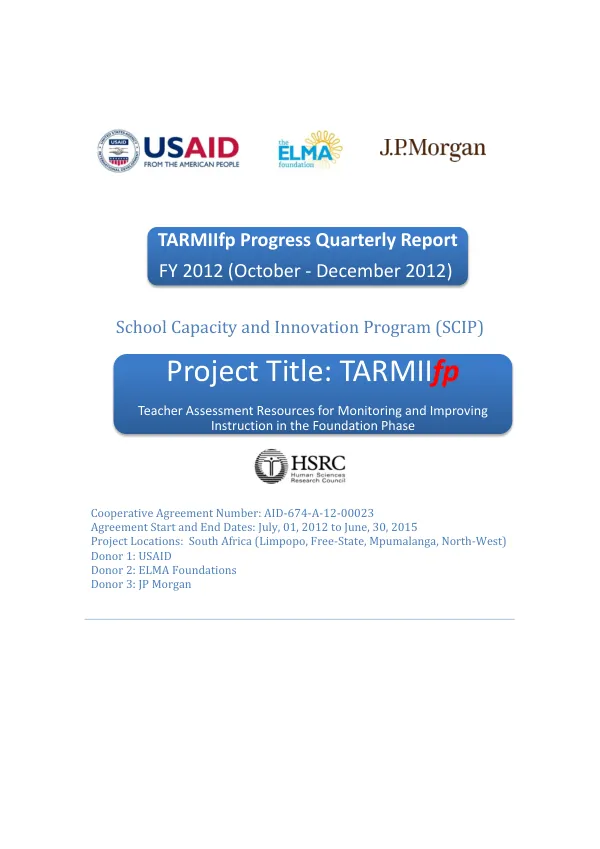
Teacher Assessment Resources for Monitoring and Improving Instruction in the Foundation Phase TARMII_fp
Sign inUSAID
Teacher Assessment Resources for Monitoring and Improving Instruction in the Foundation Phase TARMII_fp
The School Capacity and Innovation Program (SCIP) in South Africa aimed to improve teaching and assessment practices through the use of a fully developed TARMII-fp software with literacy Home Language assessment items for grades 1, 2, and 3.
2012 · 12 pages
Sign in to readA free account is required to download.
Abstract
The project was implemented in four provinces: Limpopo, Free-State, Mpumalanga, and North-West, with funding from USAID, ELMA Foundations, and JP Morgan. Project planning continued through the second quarter, with the HSRC core team engaging with districts to select project schools and set up Steering Committees in the provinces. The team worked with assessment item writers to complete English HL items and interacted with the software developer to complete the remaining modules of the software. The research team developed instruments for data collection in the provinces and submitted an application to the HSRC Research Ethics Committee for ethical approval. Provincial meetings took place in Limpopo, Mpumalanga, North West, and Gauteng/Free State provinces. In Limpopo Province, a meeting between the HSRC and the Vhembe District Senior Manager took place on October 30, 2012, to discuss the constitution of the Steering Committee and the selection of project schools. The first Steering Committee meeting was held on December 10, 2012, at the Soutpansberg East Circuit in Louis Trichardt, with the HSRC presenting the project and planned provincial activities for Year 1. In Mpumalanga, two meetings took place between the Nkangala District officials and the HSRC research team on October 2 and November 23, 2012. The October meeting deliberated on finalizing the selection of schools to participate in the study and the formation of the Steering Committee. The November meeting deliberated on the project work-plan to be used to manage project activities in the district. The district proposed a deviation from using school quintile ranking as one of the criteria for selecting project schools, and it was agreed that the HSRC in collaboration with Nkangala district officials would provide a write-up of the criterion used for selecting Nkangala schools. The project aimed to have project schools selected in Limpopo, North-West, and Mpumalanga, and Gauteng or Free-State, set up provincial steering committees, and have first Steering Committee meetings. The development of English Home Language assessment items and activities was completed, and versioning of English HL assessment items into prioritized African languages commenced. The development of TARMII-fp software, including the interface to allow teachers to contribute assessment tasks, TARMII-fp pedagogic clips, and the installation of software on computers, was also underway. The project prepared for pre-intervention data collection, and the research team developed instruments for data collection in the provinces. The project's objectives were to improve teaching and assessment practices through the use of TARMII-fp software, assess the impact of the use of the software on teacher classroom assessment practices and learner achievement in literacy, and develop a fully functional TARMII-fp software with literacy Home Language assessment items for grades 1, 2, and 3. The project's implementation was ongoing, with provincial meetings and project planning activities taking place in the second quarter of 2012.
Related documents