USAID DEC
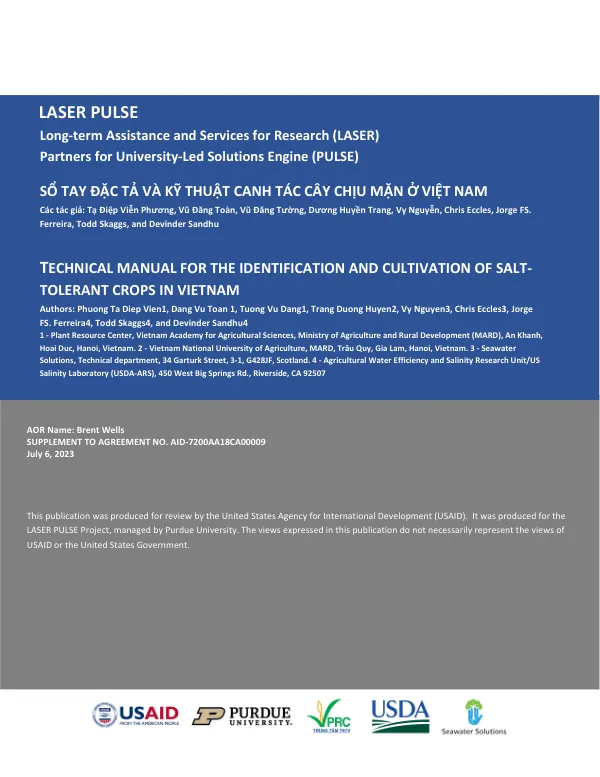
Technical Manual for the Identification and Cultivation of Salt-Tolerant Crops in Vietnam
Sign inUNIVERSIT6 DE PURDUE
Technical Manual for the Identification and Cultivation of Salt-Tolerant Crops in Vietnam
The LASER PULSE program is a 5-year initiative valued at $70 million, funded through USAID's Innovation, Technology, and Research Hub.
2023 · 67 pages
Sign in to readA free account is required to download.
Abstract
The program aims to deliver research-driven solutions to field-sourced development challenges in USAID partner countries. A consortium led by Purdue University, with core partners Catholic Relief Services, Indiana University, Makerere University, and the University of Notre Dame, implements the LASER PULSE program through a growing network of over 3,400 researchers and development practitioners in 84 countries. The program collaborates with USAID missions, bureaus, and independent offices, as well as other local stakeholders, to identify research needs for critical development challenges. LASER PULSE funds and strengthens the capacity of researcher-practitioner teams to co-design solutions that translate into policy and practice. The Technical Manual for Salt-Tolerant Crops in Vietnam is a product of the LASER PULSE program. The manual provides basic knowledge on three salt-tolerant crops: annual Sea-Blite (Suaeda maritima (L.) Dumort.), white goosefoot (Chenopodium album L.), and common purslane (Portulaca oleracea L.). The manual also discusses cultivation techniques for these crops, which can be used as alternative vegetables in coastal areas affected by seawater intrusion and wastewater from saline aquaculture farms in Vietnam. The manual highlights the potential benefits of cultivating salt-tolerant crops, including increased biodiversity in coastal ecosystems and an extra source of income for small farmers further challenged by ongoing climate change. The authors acknowledge the contributions of their partners, researchers at the Plant Resources Center, and family members who supported them in implementing their research. The manual is divided into several sections, including a glossary, leaf shapes, leaflet arrangement, stem, root, flower structure, and inflorescences. The section on rau nhót biển (annual Sea-Blite) discusses its nutritional value, distribution in Vietnam, and physical characteristics. The authors also provide information on the cultivation of rau nhót biển, including soil preparation, sowing, and harvesting. The manual is a valuable resource for farmers, women's unions, youth, and local officials who are interested in cultivating salt-tolerant crops in Vietnam. The authors welcome input from readers on how to improve and expand upon this initial volume.