WORLD WILDLIFE FUND INTERNATIONAL
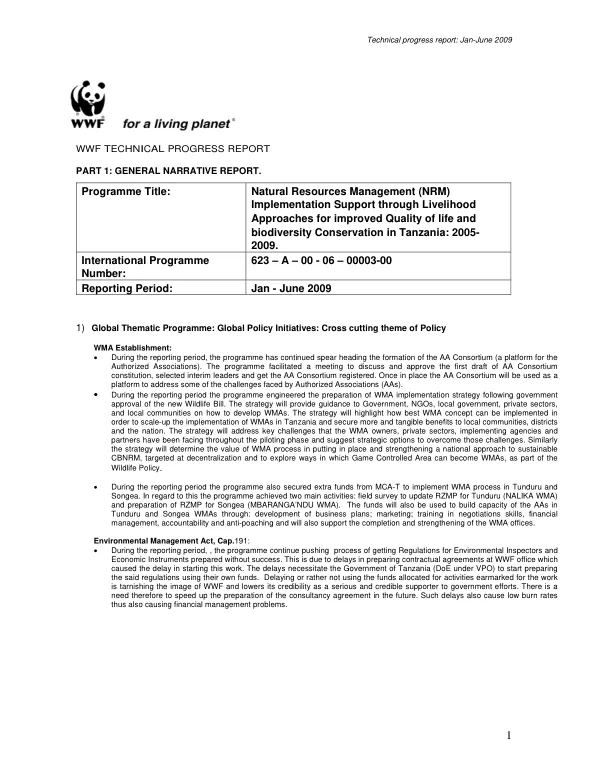
Technical Progress Report: Jan-June 2009
The Natural Resources Management (NRM) Programme in Tanzania has continued to spearhead the formation of the Authorized Associations (AA) Consortium, a platform for the Authorized Associations.
2009 · 6 pages
Sign in to readA free account is required to download.
Abstract
The programme facilitated a meeting to discuss and approve the first draft of the AA Consortium constitution, selected interim leaders, and got the AA Consortium registered. The AA Consortium will be used to address challenges faced by Authorized Associations. The programme also engineered the preparation of the Wildlife Management Areas (WMA) implementation strategy following government approval of the new Wildlife Bill. The strategy will provide guidance to government, NGOs, local government, private sectors, and local communities on how to develop WMAs. The strategy will highlight how best the WMA concept can be implemented to scale-up the implementation of WMAs in Tanzania and secure more tangible benefits to local communities, districts, and the nation. The programme secured extra funds from the Millennium Challenge Account-Tanzania (MCA-T) to implement the WMA process in Tunduru and Songea. The programme achieved two main activities: field survey to update the Resource Zone Management Plan (RZMP) for Tunduru (NALIKA WMA) and preparation of RZMP for Songea (MBARANGA’NDU WMA). The funds will also be used to build capacity of the AAs in Tunduru and Songea WMAs through development of business plans, marketing, training in negotiations skills, financial management, accountability, and anti-poaching. The programme continued pushing the process of getting Regulations for Environmental Inspectors and Economic Instruments prepared, but faced delays due to contractual agreement issues at the WWF office. The delays necessitated the Government of Tanzania to start preparing the said regulations using their own funds. The programme also supported the preparation of WMA Implementation strategy, Terms of Reference for the preparation of WMA implementation strategy were prepared and shared with all stakeholders working on WMA establishment for their inputs. The programme organized a stakeholders meeting to present the findings of JUKUMU WMA's Scoping study/report. The meeting was organized in February 2009 and invited various stakeholders including representatives from JUKUMU WMA. The stakeholders meeting deliberated on way forward and agreed actions to enable JUKUMU WMA becomes fully functional WMA. The programme also facilitated JUKUMU Society in preparation of the JUKUMU Constitution, two meetings were organized, one involving JUKUMU central committee and another one involved Society's Council. The programme supported the preparation of Land Use Plans (LUPs) for all 22 villages forming JUKUMU WMA. The programme prepared Terms of Reference for the National Land Use Planning Committee (NLUPC) to prepare the Village Land Use Plans (VLUPs). The programme was awarded MCA-T funds to support the WMA process for Tunduru and Songea. The programme conducted a stakeholders meeting to launch the MCA-T project in Tunduru and Songea. The programme achieved two main activities: a workshop and field survey to update the Resource Zone Management Plan (RZMP) for Tunduru (NALIKA WMA) and preparation of RZMP for Songea (MBARANGA’NDU WMA). The programme supported the preparation of WMA Implementation strategy. Terms of the Reference for the preparation of WMA implementation strategy were prepared and shared with all stakeholders working on WMA establishment for their inputs. Inputs were then collated and processed into a comprehensive document which was advertised in the newspaper. The bid to prepare the implementation support were received and reviewed and the winner will be awarded a contract to prepare the Strategy very soon in mid-July 2009. The programme staff, in collaboration with Wildlife Division conducted a field visit to Twatwatwa, Tarime and Loliondo WMA for 40 man-days. The aim was to conduct a WMA assessment on the reason for lagging behind and proposed way forward and priority action. A report was prepared and will be shared by all facilitators and WD and recommendations will be followed closely to facilitate the three WMAs becomes fully functional. The programme has not been able to accomplish some of the activities as planned, for example, the launch of the AA Consortium, which was planned for January 2009 due to delays in getting feedback from WMAs and AA members on the proposed formation of the AA Consortium. Similarly, there were delays in getting feedbacks from stakeholders on the Terms of Reference for the preparation of WMA implementation Strategy. In addition, there were also delays in preparing contracts at WWF office, which also contributed to delays in starting various consultancies such as the preparation of VLUPs for JUKUMU WMA, revising RZMP for Liwale and preparation of Regulations on Economic Instruments and Environmental Inspectors. The programme had expected to support training on Business and Entrepreneurship to WMA actors. This has not yet happened because the process requires involvement of various partners including the Wildlife Division and WMA facilitators. Delayed/slow decision making processes on the part of some
Related documents