USAID DEC
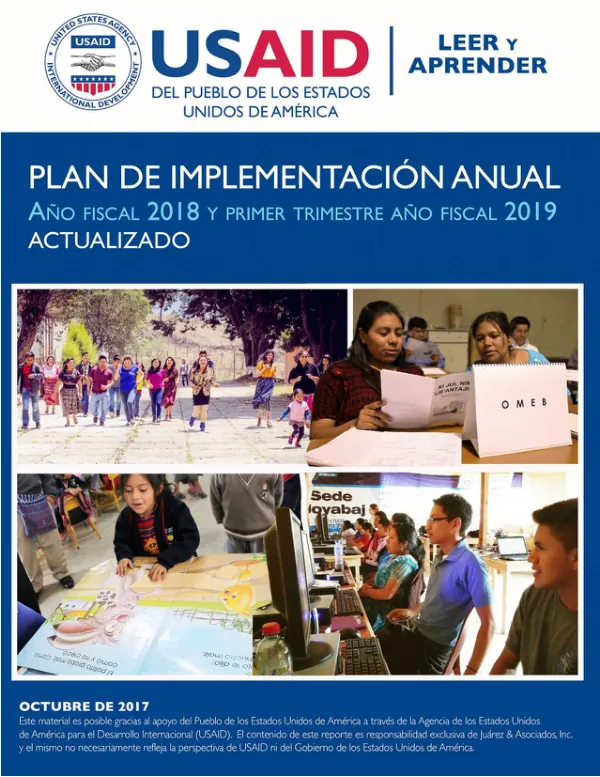
Annual Implementation Plan - Updated: Fiscal Year 2018 (October 1st, 2017 – September 30th, 2018) and First Quarter Fiscal Year 2019 (October 1st, 2018 – December 31st, 2018)
Sign inCHILD FUND INTERNATIONAL
Annual Implementation Plan - Updated: Fiscal Year 2018 (October 1st, 2017 – September 30th, 2018) and First Quarter Fiscal Year 2019 (October 1st, 2018 – December 31st, 2018)
The USAID Lifelong Learning Project aims to improve reading outcomes and increase educational access for children and indigenous youth aged 15 to 24 who are out of the school system.
2018 · 86 pages
Sign in to readA free account is required to download.
Abstract
The project is implemented in five departments in the Western Highlands of Guatemala: Huehuetenango, Quiché, Totonicapán, San Marcos, and Quetzaltenango. The project has a two-component approach: Component A, Learning to Read, and Component B, Education for Employment and Lifelong Learning. Component A focuses on improving reading skills through innovative approaches, including the use of technology and community-based programs. The project aims to reach 15,000 children and youth with reading skills training, with a focus on indigenous languages. Component B focuses on providing education and training for employment and lifelong learning, with a focus on vocational training and entrepreneurship. The project has a strong emphasis on gender equity, prevention, and addressing gender-based violence and women empowerment. Training will continue in this area to improve the quality of all interventions to the project team, Ministry of Education personnel, and grantees' representatives. The project also aims to strengthen strategic alliances with community leaders, civil society, grantees, Ministry of Education, municipalities, and other stakeholders. The project has a budget of $X, which will be used to implement the planned activities, including innovative activities, Strategic Education Activity Fund, and Grant Funds. The project also plans to continue and strengthen strategic alliances built at national, departmental, and municipal levels. The project will also provide training and capacity-building activities for the project team, Ministry of Education personnel, and grantees' representatives. The project has a strong focus on monitoring and evaluation, with a systematization of technical processes to register learning outcomes, lessons learned, good practices, and as an input to guide future actions. The project also plans to disseminate monitoring, evaluation, and research results during the project. The project has a timeline that spans from October 1st, 2017, to September 30th, 2018, and the first quarter of the fiscal year 2019 from October 1st, 2018, through December 31st, 2018. The project has a number of key stakeholders, including the Ministry of Education, municipalities, community leaders, civil society, and grantees. The project also has a number of partners, including the Universidad Panamericana, Universidad de San Carlos de Guatemala, and Universidad del Valle de Guatemala. The project's implementation will be overseen by a project coordinator, who will be responsible for ensuring that the project is implemented in accordance with the project's objectives and timeline. The project's budget will be managed by the project coordinator, who will be responsible for ensuring that the project's financial resources are used in accordance with the project's objectives and timeline. The project's financial resources will be used to implement the planned activities, including innovative activities, Strategic Education Activity Fund, and Grant Funds. The project also plans to continue and strengthen strategic alliances built at national, departmental, and municipal levels. The project's monitoring and evaluation plan will be implemented by the project coordinator, who will be responsible for ensuring that the project's progress is monitored and evaluated in accordance with the project's objectives and timeline. The project's monitoring and evaluation plan will include a systematization of technical processes to register learning outcomes, lessons learned, good practices, and as an input to guide future actions. The project also plans to disseminate monitoring, evaluation, and research results during the project. The project's timeline spans from October 1st, 2017, to September 30th, 2018, and the first quarter of the fiscal year 2019 from October 1st, 2018, through December 31st, 2018. The project's key milestones include the completion of Component A and Component B, the strengthening of strategic alliances, and the dissemination of monitoring, evaluation, and research results.
Related documents