AFRICAN BIODIVERSITY COLLABORATIVE GROUP
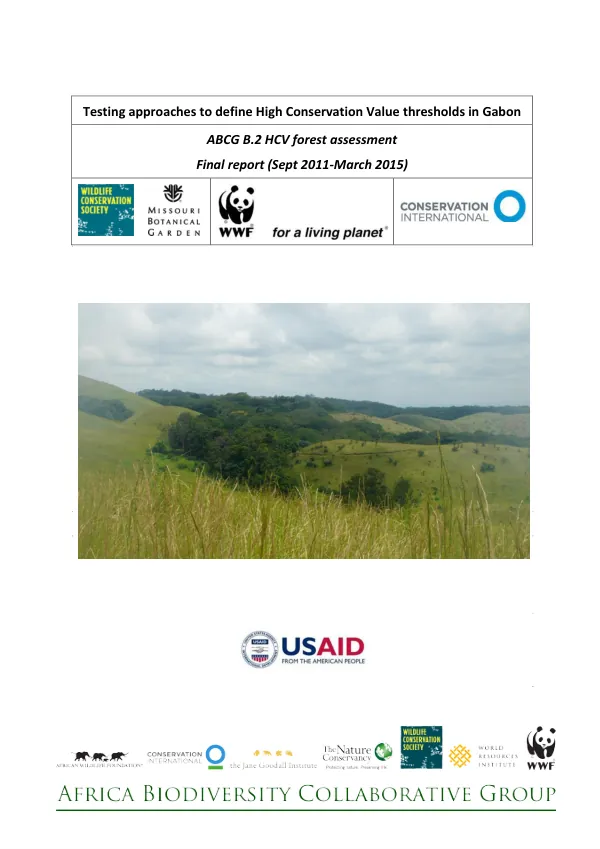
Testing approaches to define High Conservation Value thresholds in Gabon
The High Conservation Value (HCV) concept aims to provide a framework for identifying conservation values in the landscape, ensuring their continued persistence.
2015 · 52 pages
Sign in to readA free account is required to download.
Abstract
This approach emerged from forest certification and is used by the forestry and agriculture sectors as part of voluntary certification schemes. The HCV process demands that national and regional conservation priorities are taken into account in planning and management. In Gabon, the application of the HCV framework can be particularly challenging due to poor data availability. However, Gabon's largely intact forested landscapes are critically important for the continued survival of endemic and endangered species. The application of the HCV approach based on common targets and thresholds can increase the cohesion and coherence of the process. This project aimed to trial methods and provide guidance to improve decision making about the definition and management of HCV areas in Gabon. The project compiled and improved national biodiversity data sets for Gabon, demonstrating the application of various analytical approaches for the identification of HCV types 1 to 4 based on clearly articulated objectives. Large mammals were a key focus of the project, with the use of recently published models on great ape and elephant density and distribution for the region. The Zonation decision support tool was used to identify priority areas that achieve defined population targets. The project also highlighted the importance of considering national and regional conservation priorities in planning and management. The project's findings suggest that the HCV approach can be effective in identifying conservation values in the landscape. However, the application of the HCV framework can be challenging in countries with poor data availability. The project's results provide guidance for improving decision making about the definition and management of HCV areas in Gabon. The project's methodology involved the compilation and improvement of national biodiversity data sets for Gabon. Various analytical approaches were used to identify HCV types 1 to 4 based on clearly articulated objectives. The project also used the Zonation decision support tool to identify priority areas for conservation. The project's results highlight the importance of considering national and regional conservation priorities in planning and management. The HCV approach can be effective in identifying conservation values in the landscape, but its application can be challenging in countries with poor data availability. The project's findings provide guidance for improving decision making about the definition and management of HCV areas in Gabon. The project's geographic focus was on Gabon, with a particular emphasis on the country's largely intact forested landscapes. The project's results have implications for conservation efforts at national, regional, and international scales. The HCV approach can be used to complement conservation efforts at other scales and work towards the achievement of local, regional, national, and international conservation objectives. The project's timeframes were from September 2011 to March 2015. The project was supported by the American people through the United States Agency for International Development (USAID) under the terms of Cooperative Agreement No. RLA-A-00-07-00043-00. The project's results provide guidance for improving decision making about the definition and management of HCV areas in Gabon.