USAID DEC
Text messages to improve child diets: Formative research findings and protocol of a randomised controlled trial in Nepal
Sign inHELLEN KELLER INTERNATIONAL
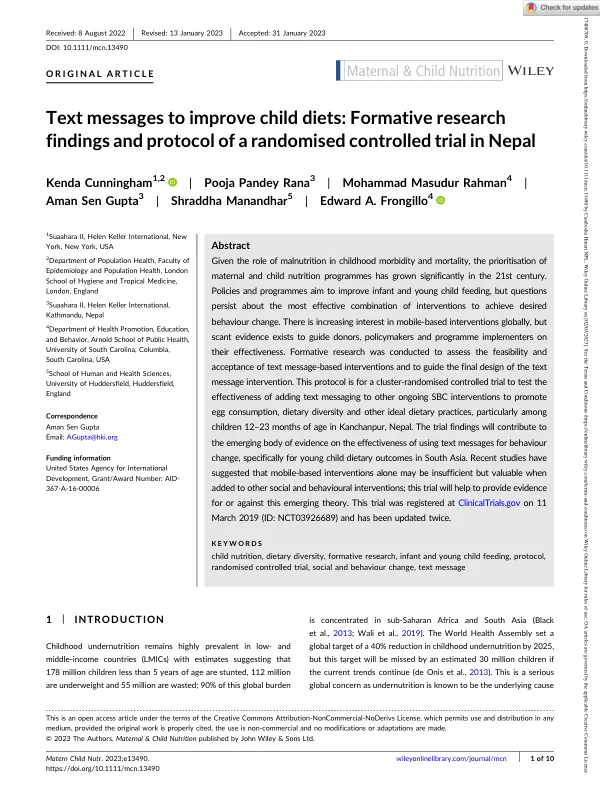
Text messages to improve child diets: Formative research findings and protocol of a randomised controlled trial in Nepal
Childhood undernutrition remains highly prevalent in low- and middle-income countries, with estimates suggesting that 178 million children less than 5 years of age are stunted, 112 million are underweight, and 55 million are wasted.
2023 · 10 pages
Sign in to readA free account is required to download.
Abstract
The World Health Assembly set a global target of a 40% reduction in childhood undernutrition by 2025, but this target will be missed by an estimated 30 million children if current trends continue. Undernutrition is known to be the underlying cause of more than one-third of childhood deaths globally. The time between a child's birth and 2 years of age is a critical window of opportunity to ensure a child's development, in part through proper feeding practices. Even mild or moderate undernutrition during this period can cause irreversible damage. Improper infant and young child feeding (IYCF) practices are a main factor contributing to high rates of child undernutrition in many countries. Recommended IYCF practices have the potential to prevent an estimated 19% of all under-5 deaths, more than any other single preventive intervention. In Nepal, significant reductions in undernutrition among children over the last several decades have been well documented. However, among Nepalese children under 5 years of age, 36% are stunted and 10% are wasted. Complementary feeding practices, known to be important for nutrition outcomes, remain poor in Nepal. Eggs, a food well-known to be highly nutritious, are only consumed by 10% of children 6-23 months of age. A recent randomised controlled trial conducted among young undernourished children in the Ecuadorian Andes showed significant effects on the reduction of stunting after the children consumed eggs for just 6 months. Eggs are considered a complete food and arguably more accessible and affordable to resource-poor populations than other nutritious complementary foods. They are also relatively simple to store and prepare. However, eggs are not widely consumed among children and women of reproductive age, particularly in low-income settings. Inadequate parental knowledge is a main contributor to inappropriate IYCF and egg consumption practices in Nepal, specifically in the lowland plains. Social and behaviour change (SBC) theory can be a useful component of nutrition interventions, and studies have repeatedly shown that when target populations are reached with greater frequency and intensity, there is a greater likelihood of behaviour change. Recent analyses of USAID-funded Suaahara (Integrated Nutrition Program) data confirmed this for nutrition interventions in Nepal. Evidence from a recent trial shows the effectiveness of culturally tailored behaviour change strategies, particularly when combined with addressing resource constraints, to improve young child egg consumption and reduce malnutrition. Timely and important information increases knowledge and may also serve as an important reminder or highlight the importance of a behaviour that may not be traditionally valued, even for those who are already knowledgeable. The use of mobile platforms for providing health services (mHealth) or spreading critical information and motivation for behaviour change is growing, and sending short message service (SMS) via mobile phone may be an inexpensive, non-labour-intensive channel of communication to reach households residing in remote areas with important health and nutrition information.
Related documents
Documents in this collection
 2021
2021USAID DEC
Associations between parents' exposure to a multisectoral programme and infant and young child feeding practices in Nepal
Open record 2017
2017USAID DEC