UNICEF
The Baby-Friendly Hospital Initiative (BFHI) Checklist
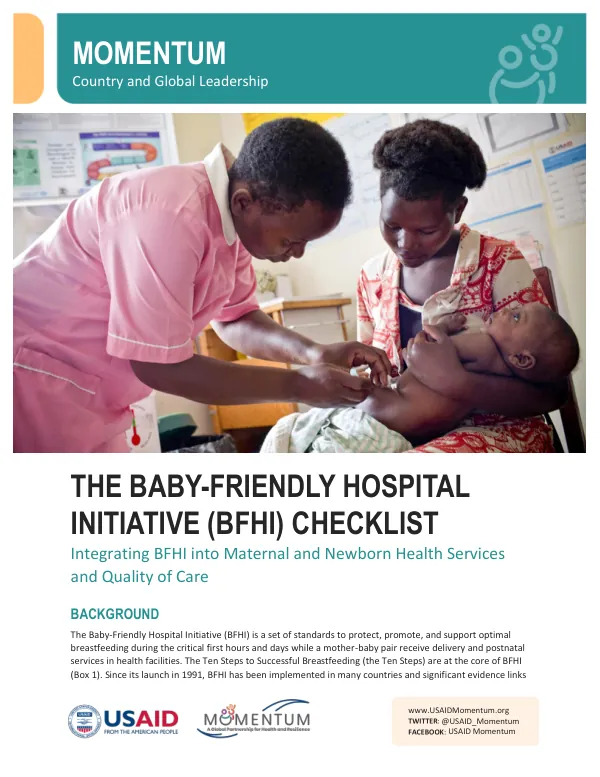
The Baby-Friendly Hospital Initiative (BFHI) is a set of standards to protect, promote, and support optimal breastfeeding during the critical first hours and days while a mother-baby pair receive delivery and postnatal services in health facilities.
2023 · 18 pages
Sign in to readA free account is required to download.
Abstract
The Ten Steps to Successful Breastfeeding are at the core of BFHI, which have been implemented in many countries since its launch in 1991. Significant evidence links implementation of the Ten Steps with improved breastfeeding practices, including exclusive breastfeeding. The World Health Organization (WHO) published a vision and framework for quality care for women, newborns, and children in 2015, and subsequently published quality-of-care (QoC) standards, statements, and measures for facility-based maternal and newborn health care services in 2016, pediatric and young adolescent health care services in 2018, and small, sick newborn (SSNB) health care services in 2020. Nutrition care and services, including the Ten Steps, are an important component of these standards. The 2020 SSNB standards include nutrition quality standards specific to preterm and/or low-birthweight (LBW) newborns with/without complications, including assisted feeding with mother's milk. In 2020, the WHO also published BFHI guidance to specifically address breast-milk feeding and special feeding recommendations for SSNBs. Based on the revised BFHI guidance, WHO published an updated BFHI training course for health workers providing maternity and newborn services. A new competency verification toolkit was developed in 2020 to shift the focus from standalone training to ensuring that staff are equipped with the knowledge, skills, and attitudes to implement the Ten Steps. The Ten Steps of BFHI can be mapped to WHO's maternal and newborn health (MNH) and SSNB quality statements and measures across several quality domains. This provides an opportunity to integrate BFHI quality standards by co-leveraging BFHI and MNH/SSNB QoC activities at national, sub-national, and health facility levels. However, BFHI quality improvement (QI) activities and monitoring remain vertical. There is a need to promote the integrated implementation of BFHI's Ten Steps and the QoC standards and measures within existing sub-national and facility-level MNH QI plans and capacity development activities. This checklist, developed by the U.S. Agency for International Development's MOMENTUM Country and Global Leadership project, aims to provide health facilities and district managers with practical guidance to ensure the integration and institutionalization of the BFHI Ten Steps within routine antenatal care (ANC), intrapartum care, and postnatal care (PNC), including SSNB services and QI activities. The checklist may also be used by health facility managers and health workers involved in maternal and newborn care and nutrition, including ministry of health sub-national and district health managers. The checklist can also support district health offices and facilities to track the integration of the Ten Steps. The checklist presents the BFHI Ten Steps and WHO's MNH and SSNBs QoC nutrition specific statements, standards, and measures, alongside targeted actions for integration throughout the continuum of MNH care services and QoC/QI efforts. It is a key assumption of this checklist that the ministry of health (national and sub-national) has established the necessary supportive policies and procedures to enable BFHI at the facility level, as described under Step 1: Critical Management Procedure. It is further assumed that the ministry of health is committed to scaling up BFHI by integrating the Ten Steps within existing MNH policies, procedures, and service delivery. The checklist provides a step-by-step guide for health facilities and district managers to ensure the integration and institutionalization of the BFHI Ten Steps within routine ANC, intrapartum care, and PNC, including SSNB services and QI activities. The checklist includes a facility appraisal tool, modified from the UNICEF/WHO BFHI Hospital Self-Appraisal and Monitoring Tool, to assess existing practices, identify gaps, and leverage actions to integrate the Ten Steps into MNH and QoC (QI, measures, and monitoring) service packages.