USAID
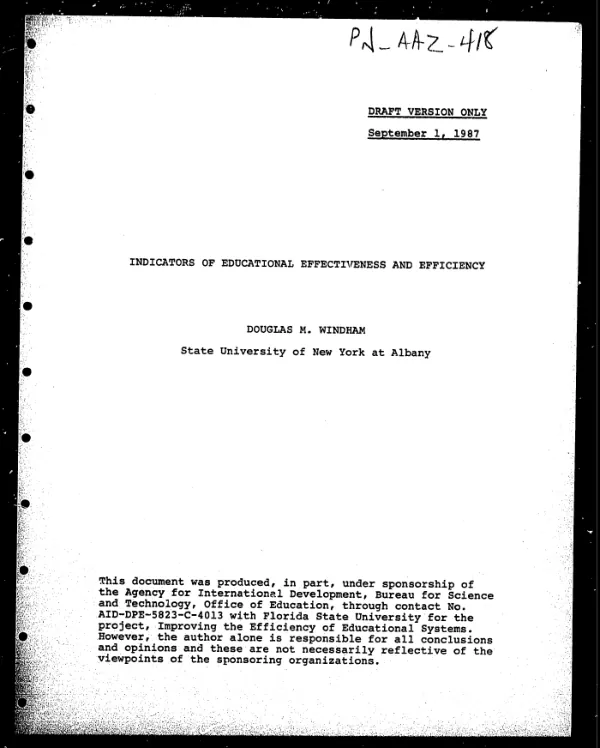
The Concept of Educational Efficiency: An Introduction
The concept of educational efficiency has gained significant attention in recent years, particularly in developing nations where fiscal constraints and heightened demand for resources have become pressing concerns.
2009 · 357 pages
Sign in to readA free account is required to download.
Abstract
The role of education in development has been extensively studied, with economists examining the relationship between education and economic growth. In this context, the concept of educational efficiency has evolved into three forms of discussion: rhetorical, conceptual, and practical. Rhetorical discussions of educational efficiency are often found in national planning documents and policy papers of international donor agencies. However, these discussions rarely operationalize the concept of efficiency, and even when used as a general concept, it is often unclear whether efficiency is meant to exist as a goal in and of itself or as a means to some other end. The efficiency movement is often viewed as a means of increasing the availability of funds required to improve educational access and/or quality. Economists have focused on conceptual and definitional distinctions, examining internal versus external efficiency, private versus social costs and effects, and technical versus economic efficiency. While these distinctions have been useful to noneconomists who have mastered the terminology, few educational administrators and policymakers have been persuaded to do so due to the complexity of the economic literature. In response to these challenges, this monograph aims to identify appropriate quantitative measures of educational effectiveness and efficiency that may be used in assessing education at multiple levels of the educational system. These statistical indicators of educational effectiveness and efficiency are required to document the present status of educational activities, establish alternative goals for the education and human resources (EHR) system, and operate as benchmarks to define systemic progress toward better utilization of existing resources by the educational system or by individual educational organizations. The monograph is designed as a companion volume to Chapman and Windham's The Evaluation of Efficiency in Educational Development Activities (1986), which examined issues related to the design and conduct of program and project evaluation of activities that have the enhancement of educational efficiency as a goal. While the prior monograph dealt extensively with the context, techniques, and processes of efficiency evaluation, it did not deal in detail with the alternative means of operationalizing effectiveness or efficiency concepts. The monograph will focus on identifying indicators of effectiveness in educational production, including input indicators such as teacher characteristics, facilities, equipment, educational materials, and administrative capacity. Process indicators, such as administrative behavior, teacher time allocations, and specific student behaviors, will also be examined. Output indicators, such as attainment effects, achievement effects, attitudinal/behavioral effects, and equity effects, will be discussed in detail. The monograph will also examine the relationship between educational efficiency and economic growth, highlighting the importance of operationalizing the concept of efficiency in the context of education and development. By providing a comprehensive framework for assessing educational effectiveness and efficiency, this monograph aims to contribute to the ongoing debate over the role of education in development and the importance of efficiency in achieving educational goals.