USAID DEC
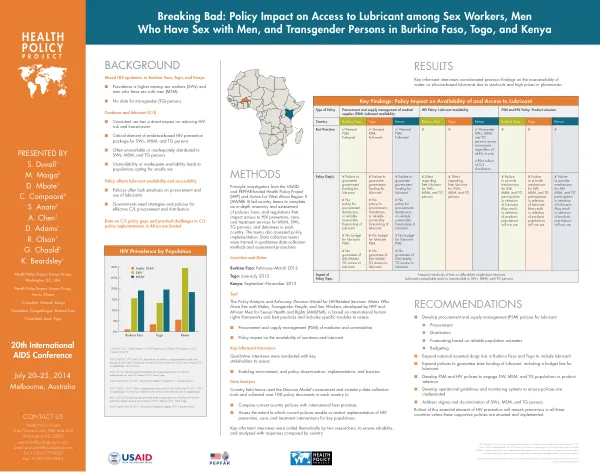
Breaking Bad: Policy Impact on Access to Lubricant among Sex Workers, Men Who Have Sex with Men, and Transgender Persons in Burkina Faso, Togo, and Kenya
Sign inFUTURES GROUP INTERNATIONAL, LLC
Breaking Bad: Policy Impact on Access to Lubricant among Sex Workers, Men Who Have Sex with Men, and Transgender Persons in Burkina Faso, Togo, and Kenya
The Health Policy Project, a five-year cooperative agreement funded by the U.S.
2014 · 1 pages
Sign in to readA free account is required to download.
Abstract
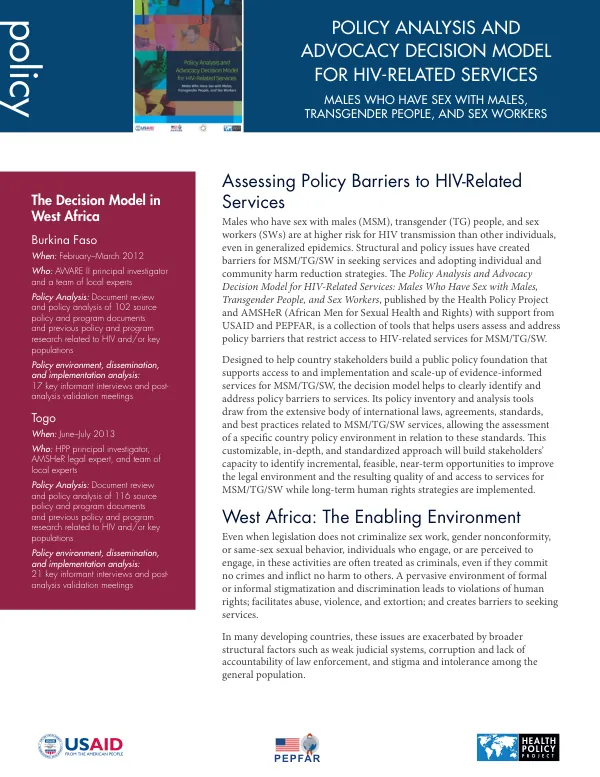
Agency for International Development, conducted an in-depth inventory and assessment of policies, laws, and regulations impacting access to HIV prevention, care, and treatment services for key populations in Burkina Faso, Togo, and Kenya. The project, led by principle investigators from the Health Policy Project and Action for West Africa Region II, aimed to assess policy implementation and identify policy gaps affecting access to HIV services. The assessment focused on the availability and accessibility of condoms and lubricants, critical elements of evidence-based HIV prevention packages for men who have sex with men (MSM), sex workers (SWs), and transgender (TG) persons. The project used the Policy Analysis and Advocacy Decision Model for HIV-Related Services, developed by the Health Policy Project and African Men for Sexual Health and Rights, to assess policy impact on the availability of condoms and lubricants. Key informant interviews and data analysis revealed that policy gaps and practical challenges hindered the implementation of effective condom and lubricant procurement and distribution policies in the three countries. The assessment identified several policy gaps, including the failure to guarantee government funding for lubricant, lack of policies for procurement, distribution, and reliable commodity forecasting of lubricant, and absence of budgets for lubricant procurement and supply management. The results of the assessment highlighted the inaccessibility of water- or silicone-based lubricants due to stockouts and high prices in pharmacies. The project found that frequent stockouts of free or affordable single-dose lubricant and lubricant unavailability and/or inaccessibility to SWs, MSM, and TG persons were common in the three countries. Based on the findings, the project made several recommendations to address the policy gaps and improve access to condoms and lubricants for key populations. These recommendations included developing procurement and supply management policies for lubricant, expanding national essential drugs lists to include lubricant, and engaging SW, MSM, and TG populations in product selection. The project also recommended developing operational guidelines and monitoring systems to ensure policy implementation and addressing stigma and discrimination of SWs, MSM, and TG persons. The rollout of this essential element of HIV prevention will remain precarious in all three countries unless these supportive policies are enacted and implemented.