USAID
The Emergence of Ethnic Citizenship in Colombia: Spotlight
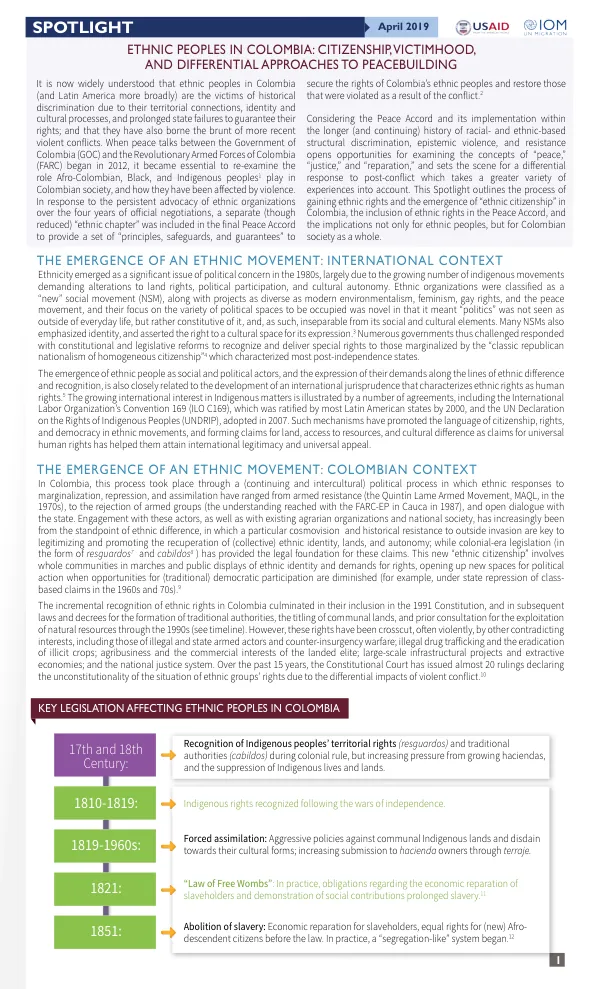
Ethnicity emerged as a significant issue of political concern in the 1980s, largely due to the growing number of indigenous movements demanding alterations to land rights, political participation, and cultural autonomy.
2019 · 4 pages
Sign in to readA free account is required to download.
Abstract
These movements were classified as a "new" social movement (NSM), along with projects as diverse as modern environmentalism, feminism, gay rights, and the peace movement. The focus of NSMs on various political spaces to be occupied was novel, as it meant "politics" was not seen as outside of everyday life, but rather constitutive of it, and inseparable from its social and cultural elements. Many NSMs also emphasized identity, asserting the right to a cultural space for its expression. The emergence of ethnic people as social and political actors, and the expression of their demands along the lines of ethnic difference and recognition, is closely related to the development of an international jurisprudence that characterizes ethnic rights as human rights. The growing international interest in Indigenous matters is illustrated by a number of agreements, including the International Labor Organization's Convention 169 (ILO C169) and the UN Declaration on the Rights of Indigenous Peoples (UNDRIP). These mechanisms have promoted the language of citizenship, rights, and democracy in ethnic movements, and forming claims for land, access to resources, and cultural difference as claims for universal human rights has helped them attain international legitimacy and universal appeal. In Colombia, the process of gaining ethnic rights took place through a (continuing and intercultural) political process in which ethnic responses to marginalization, repression, and assimilation have ranged from armed resistance to open dialogue with the state. Engagement with these actors, as well as with existing agrarian organizations and national society, has increasingly been from the standpoint of ethnic difference, in which a particular cosmovision and historical resistance to outside invasion are key to legitimizing and promoting the recuperation of (collective) ethnic identity, lands, and autonomy. This new "ethnic citizenship" involves whole communities in marches and public displays of ethnic identity and demands for rights, opening up new spaces for political action when opportunities for (traditional) democratic participation are diminished. The incremental recognition of ethnic rights in Colombia culminated in their inclusion in the 1991 Constitution, and in subsequent laws and decrees for the formation of traditional authorities, the titling of communal lands, and prior consultation for the exploitation of natural resources. However, these rights have been crosscut, often violently, by other contradicting interests, including those of illegal and state armed actors and counter-insurgency warfare; illegal drug trafficking and the eradication of illicit crops; agribusiness and the commercial interests of the landed elite; large-scale infrastructural projects and extractive economies; and the national justice system. Over the past 15 years, the Constitutional Court has issued almost 20 rulings declaring the unconstitutionality of the situation of ethnic groups' rights due to the differential impacts of violent conflict. The recognition of ethnic rights in Colombia has also led to the inclusion of ethnic peoples in the peace process, particularly in the context of the peace talks between the Government of Colombia (GOC) and the Revolutionary Armed Forces of Colombia (FARC). A separate "ethnic chapter" was included in the final Peace Accord to provide a set of "principles, safeguards, and guarantees" to secure the rights of Colombia's ethnic peoples and restore those that were violated as a result of the conflict. This has opened opportunities for examining the concepts of "peace," "justice," and "reparation," and sets the scene for a differential response to post-conflict which takes a greater variety of experiences into account.
Related documents