USAID
Jagual Río Chintadó and Quiparadó REDD+ Pre-Feasibility Report
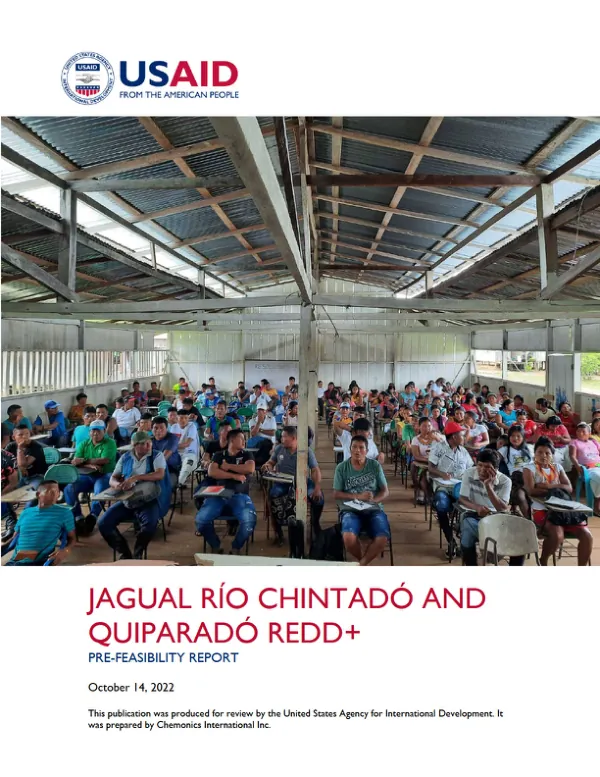
The Jagual Río Chintadó and Quiparadó Indigenous reserves are located in the municipality of Riosucio, Chocó, in northwestern Colombia.
104 pages
Sign in to readA free account is required to download.
Abstract
The reserves are home to the Embera and Wounaan communities, who have legal land title to the territories. The primary drivers of deforestation in this region are logging, small-scale agriculture, and cattle ranching. The economy of the indigenous communities is tied to the territory and its history, with a strong focus on natural resource extraction and monoculture farming. The communities have a high level of exploitation of natural resources, which has sociocultural effects and consequences for territorial control. The Jagual communities practice a soil/crop rotation system based on slashing, burning, and sowing, mainly rice. This system involves leaving the soil to recover for a period of time, creating areas known as stubbles. The stubble system has several stages, including high mountain stubble and low mountain stubble. Other productive activities take place in these areas, including the cultivation of crops such as rice, maize, and beans. The communities also engage in small-scale agriculture, including the production of coffee, cocoa, and other crops. The primary project design considered in this study is avoided forest conversion through a Reducing Emissions from Deforestation and Forest Degradation (REDD) methodology. The intention is to use the revenues from the sale of carbon credits to support activities that address the agents and drivers of deforestation, provide alternative livelihoods, and fund community development projects. The study analyzes the technical and financial feasibility of a potential carbon project for these communities. The assessment of national REDD+ policy and context in Colombia is compared to greenhouse gas (GHG) programs and methodologies for their suitability. Baseline conditions and rates of deforestation are determined through remote sensing and site visits, and baseline estimates are used to determine potential project crediting scenarios. The financial feasibility of the project is assessed by comparing estimated revenues with project implementation costs and evaluating marketability. Potential risks to the project are identified and recommendations for risk mitigation and further project development are proposed. The study aims to stabilize and transform territories most affected by violence and poverty by promoting rural economic development and capacity building. The project would be implemented by the indigenous communities themselves with national implementation partners supporting their technical and territorial governance capacity. The primary drivers of deforestation in this region are illegal logging and small-scale agriculture, including some areas of illicit coca cultivation. The indigenous communities have legal land title to the territories considered in this study and carbon finance could support forest protection, sustainable agriculture, and other activities that reduce the current levels of deforestation and forest degradation in the project area while enhancing their traditional identity. The study concludes that the Jagual Río Chintadó and Quiparadó Indigenous reserves have significant potential for a carbon project that addresses deforestation and forest degradation. The project could provide alternative livelihoods and support community development priorities, while also contributing to the development of sustainable agriculture and forest protection practices.