USAID DEC
The Failure of the U.S. Environmental Decision-making Process: Will a Better Way Emerge?
Sign inUSAID DEC
The Failure of the U.S. Environmental Decision-making Process: Will a Better Way Emerge?
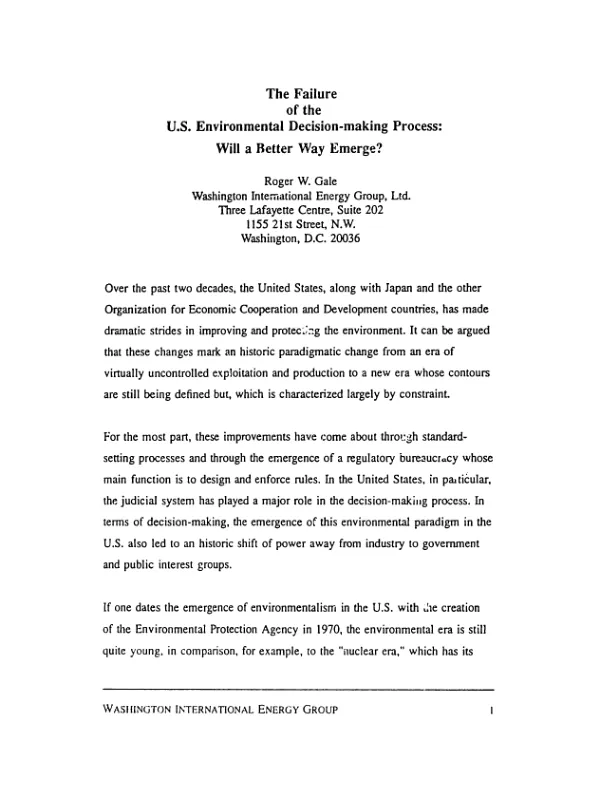
The environmental decision-making process in the United States has undergone significant changes over the past two decades, with a shift from an era of uncontrolled exploitation and production to a new era characterized by constraint.
2010 · 21 pages
Sign in to readA free account is required to download.
Abstract
This paradigmatic change has led to the emergence of a regulatory bureaucracy whose main function is to design and enforce rules. The judicial system has played a major role in the decision-making process, and the power has shifted away from industry to government and public interest groups. The environmental era in the US is still relatively young, dating back to the creation of the Environmental Protection Agency in 1970. However, its performance can be judged, and it is this author's judgment that the means by which environmental decisions are made in the US is in need of fundamental reform. The current approach to achieving environmental goals has proven too contentious, costly, and cumbersome, resulting in sub-optimal outcomes. Other nations, including Japan, have been able to accomplish as much or more in the environmental sphere through more steady and direct means. These strategies have actually enhanced the rate of economic growth, and the Japanese decision-making process is characterized by its collusion, which can also be described as collaboration toward achieving widely shared societal goals. A classic example of this is the speed with which Honda and other Japanese automakers were able to design automobile engines that were both more efficient and less polluting. The problems witnessed in the environmental decision-making process are reflected in other areas, including the failure of the financial system, overspending on defense, underspending on education, and a lack of shared goals. The emergence of a powerful but not necessarily effective bureaucracy that exercises considerable control over a complex and time-consuming confrontational decision-making process is a significant issue. This bureaucracy has relatively little accountability, and in recent years, it has been dominated by political appointees who exemplify little of the character of the strong, elite career bureaucracies in Japan and elsewhere. The debate on decision-making has been lacking in fresh thinking about the bureaucratic phenomenon, despite the rich history of literature about bureaucracy from Europe. The US has customarily ignored bureaucratic theory and, therefore, virtually ignored the extent to which the environmental era has ushered in a rampant bureaucratism in its wake. For the first time in recent US history, government employment exceeds the total number of people employed in the manufacturing sector. From the point of view of US industry, many of the demands made by the environmental bureaucracy are seen as excessively expensive in comparison to the benefits they offer. An increasingly large component of that cost is believed to be related to administration, rather than technology or hardware investments. The large number of Fortune 500 companies that depend on government contracts for a significant share of their business is also a disheartening sign. When the number of employees of these companies and numerous consulting firms, known as the "Beltway bandits," are added to the government sector roster, the total number of Americans employed by the government or the government sector has grown enormously since the Second World War. The divided government in Washington, the federal system with its strong state-level power, the emergence of powerful interest groups, and the excessive reliance on lawyers are often cited as the primary sources of what is wrong with the US today. However, there is a more fundamental and deep-seated system failure that is the product of divided government. This failure is clearly seen in the environmental decision-making arena, where an enormous and unwieldy regulatory bureaucracy has assumed powers far beyond those envisioned by either Congress or the White House. Even relatively straightforward, non-controversial power plant projects must be reviewed by as many as eight to ten different state and federal agencies, which only sometimes fail to coordinate their actions even when they are enforcing the same laws.