USAID DEC
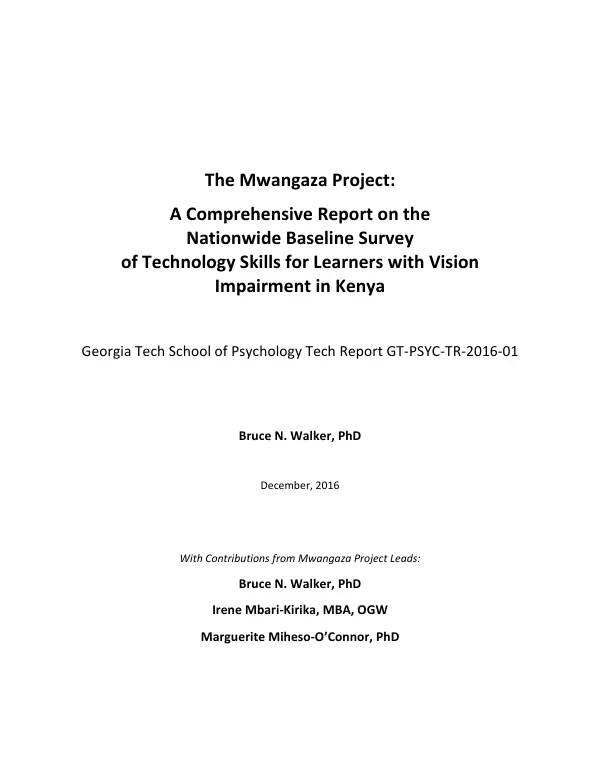
The Mwangaza Project: A Comprehensive Report on the Nationwide Baseline Survey of Technology Skills for Learners with Vision Impairment in Kenya
Sign inUSAID DEC
The Mwangaza Project: A Comprehensive Report on the Nationwide Baseline Survey of Technology Skills for Learners with Vision Impairment in Kenya
The Mwangaza Project is a collaborative research initiative between the Sonification Lab at Georgia Tech, inABLE, a non-profit organization based in Kenya and Washington DC, and Kenyatta University.
2016 · 56 pages
Sign in to readA free account is required to download.
Abstract
The project aims to improve technology skills and STEM education for learners with vision impairment in Kenya. The research team conducted a nationwide baseline survey to assess the technological skills and experience of blind and low-vision students in Kenya, as well as their teachers. The survey was a critical component of the project, as there was a lack of data on technology skills for children with vision loss in Africa. The research team sought to understand the experiences of blind students in Kenya with respect to technology, their perspectives on career choices, aspirations, and other psycho-social measures. The survey aimed to provide a baseline against which the success of the project could be measured. The Mwangaza Project has a three-phase approach. The first phase involved conducting the nationwide baseline survey of technological skills and experience of blind and low-vision students in Kenya, as well as their teachers. The second phase involved deploying GT Sonification Lab STEM education software, curriculum, and training at some Schools for the Blind in Kenya, along with inABLE-operated computer programs. The third phase, which is beyond the scope of this document, involves repeating the nationwide survey after more computer training programs have been implemented and additional STEM tools have been deployed. The project team has a diverse composition, with members from Georgia Tech, inABLE, and Kenyatta University. The team has been working together to identify the specific needs of Kenyan students with vision loss and their teachers, to help inABLE tweak its computer training program and Georgia Tech to adjust or develop tools and resources that will be appropriate for blind and low-vision Kenyan learners. The Mwangaza Project has received funding from the USAID/NSF PEER program, which aims to address global development challenges through partnerships between US government-funded researchers and scientists and engineers in developing countries. The project has the potential to make a significant impact on the lives of blind individuals in Kenya by providing them with marketable computing skills and a better education, including STEM topics. The project's goals are ambitious, and the research team is committed to documenting the effectiveness of their projects through systematic data collection efforts. The team has already implemented the first two phases of the project, and the results of the nationwide baseline survey are presented in this document. The survey provides valuable insights into the technological skills and experience of blind and low-vision students in Kenya, as well as their teachers. The results of the survey indicate that most students in Kenya have very little technology experience and few resources. However, the survey also highlights the potential for great synergy between Georgia Tech and inABLE, as well as the importance of developing tools and methods that are tailored to the local context. The project's findings have significant implications for the development of technology skills and STEM education for learners with vision impairment in Kenya. The Mwangaza Project has the potential to make a lasting impact on the lives of blind individuals in Kenya by providing them with the skills and knowledge they need to succeed in a rapidly changing world. The project's success will depend on the ability of the research team to work together effectively, to identify the specific needs of Kenyan students with vision loss and their teachers, and to develop tools and resources that are tailored to the local context.
Related documents