USAID DEC
The Power of the Purse: A Market Approach to Stimulating Private Sector Investment in Women
Sign inMERCY CORPS INTERNATIONAL
The Power of the Purse: A Market Approach to Stimulating Private Sector Investment in Women
Markets that are inclusive and work effectively can enable the poor and marginalized to meet their needs in the short term and to work their way out of poverty in the long term.
2015 · 10 pages
Sign in to readA free account is required to download.
Abstract
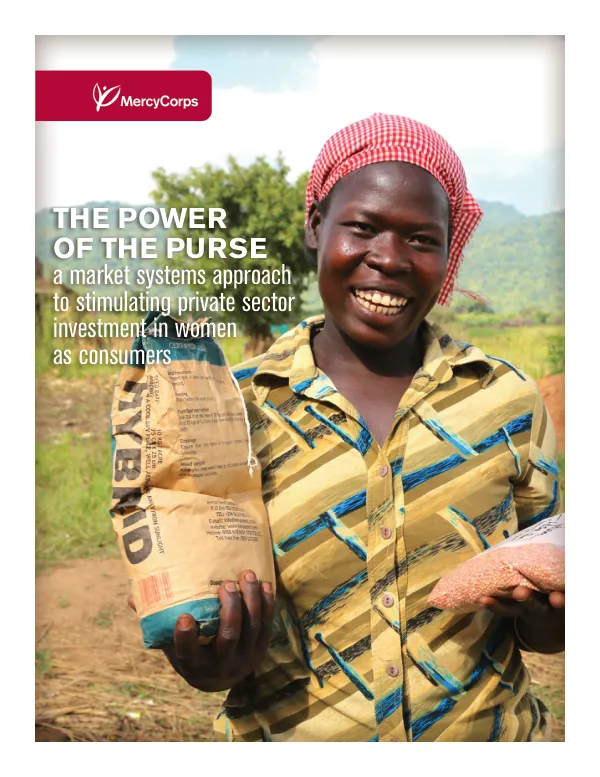
Market systems development (MSD) programs leverage the private sector to build inclusive local markets that benefit the poor. Increasingly, MSD programs are recognized as a key means of achieving sustainable impact at scale. Markets function differently for men and women, and the MSD approach does not explicitly encourage practitioners to address gender dynamics. However, over the past two years, women and gender have received growing attention. Practitioners have realized that failing to consider an intervention's gender dynamics can result in programs that miss the mark. Evidence shows that when poor women have the means to improve their income and the power to make decisions, the positive impacts extend beyond themselves to their immediate household and the wider community. Women currently constitute the largest emerging market, with globally USD 20 trillion in spending and their earning potential increasing at a much faster than men's. Harnessing women's potential as consumers could have a significant, positive impact for businesses and for development, since women invest heavily in their families and communities. Despite this potential, markets are often unfavorable for women's participation, reinforcing structural inequalities and uneven access to products and services. Stimulating markets to be more gender responsive is a clear win for women, families, businesses, and development goals. However, very little guidance is available to practitioners interested in integrating gender concerns into market systems work beyond analytical frameworks. The Power of the Purse (POP) pilot was designed to develop and test a Women's Economic Empowerment (WEE) approach to addressing gender dynamics within MSD programs. The POP pilot was implemented under Mercy Corps in Karamoja, a pastoralist area of Uganda undergoing an agricultural transition. The team used research to establish women's spending power and made the economic case for investing in women as consumers. One-on-one coaching with businesses was provided to improve the gender sensitivity of their product and service offerings. A post-pilot assessment measured the impact of the project, which showed promising results and offered a starting point for market systems practitioners seeking strategies to catalyze economic growth that benefit women and girls. Mercy Corps has a growing portfolio of MSD projects working to address the causes of long-standing, systemic poverty. While these projects show promise, the results can be uneven, with men, boys, and middle-income individuals tending to benefit more than women and the poor. Mercy Corps' experience with MSD in East Acholi, Uganda, demonstrated a 137% increase in smallholder farmers' income in target communities, but no improvement for the bottom 24%. The evaluation also indicated that domestic violence escalated, as couples argued over the use of surplus income. The POP project was designed to inform market actors on the economic opportunity presented by female consumers in Northern Karamoja. The hypothesis was that if businesses understood women's importance as consumers, they would invest in them as employees, sales representatives, and entrepreneurs. Women could provide valuable insights into this customer base and help unlock client networks and opportunities that might otherwise be inaccessible to businesses. The underlying assumption in this approach is that market-driven change that addresses, rather than reinforces, gender inequities is more likely to take place if businesses are presented with a compelling business case. This approach assumes a level of openness on the part of businesses to recommendations that could be profitable but contradict deeply ingrained biases about the role and potential of women in markets and society. Over the long term, private sector investment is expected to contribute to greater equality, as women and girls gain access to products and services that enhance their quality of life. In a context like Karamoja, where government is either unwilling or unable to finance local development, and international donors are looking for ways to scale back support, the private sector may be the region's best hope for driving gender equality and economic growth. The POP approach includes five distinct phases, each aimed at leveraging market behavior change strategies to drive up businesses' bottom line while benefiting women and girls. Throughout this process, project staff played a critical role as brokers of high-quality, gender-related market information and as facilitators, coaching, and working with businesses to respond to this information. The goal was to generate a win-win situation for businesses, their customers, and women and girls.