J.D.G. COMMUNICATIONS, INC.
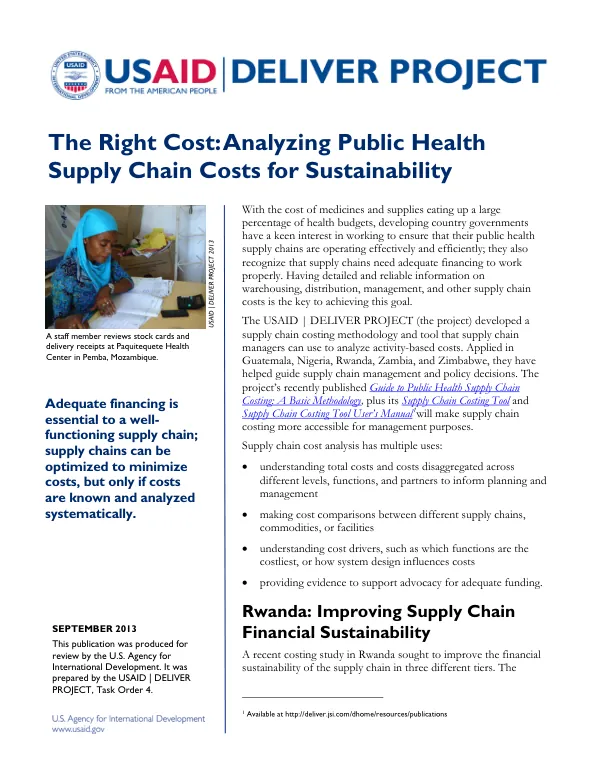
The Right Cost: Analyzing Public Health Supply Chain Costs for Sustainability
The public health supply chain in developing countries faces significant challenges in terms of cost and financial sustainability.
2013 · 4 pages
Sign in to readA free account is required to download.
Abstract
In Rwanda, the public health supply chain stores products at the central level, at 30 district pharmacies, and at over 500 service delivery points, including primary, secondary, and tertiary facilities. A cadre of over 30,000 community health workers completes the system. Central medical stores charge handling fees as a percentage of the unit value of the goods, but these fees are often loosely related to the actual cost of handling a particular commodity. The government of Rwanda introduced a management fee of 9 percent (per product value) in 2008 to enable the Medical Procurement and Distribution Division (MPDD) to cover management costs for central storage and distribution of donated commodities and to accrue capital for future investment. However, the value of the commodities handled per year has increased 15-fold since 2008, while management costs have only increased four-fold. Despite the management fee, donor partners and health programs have not been uniformly charged for MPDD's services, leading to inequitable funding and financial sustainability issues. A recent costing study in Rwanda sought to improve the financial sustainability of the supply chain in three different tiers. The study estimated total, functional, and system tier-specific supply chain costs across all health programs and provided recommendations for management fees that could equitably fund supply chain operations. The results of the study helped explain key financing issues, clarified the important but under-funded role of district pharmacies, and informed the following recommendations. To improve financial sustainability, the study recommended that MPDD be authorized to apply a uniform 14 percent management fee for procurement, storage, and distribution, or 8 percent for storage and distribution only. Additionally, the study recommended that long-term financing be secured for district pharmacies, which have a key role in the storage and distribution of commodities for over 500 service delivery points. The study also highlighted the need to analyze and address the cause of commodity expiries, which account for as much as 31 percent of central-level operating expenses. Costing exercises have also been conducted in other countries, including Nigeria and Zambia, to inform policy decisions and test system design options. In Nigeria, a costing exercise revealed that the contraceptive logistics management system had an annual operating deficit of $518,000 and that an imbalance in the fee structure resulted in a large deficit for local governments and service delivery points. In Zambia, a costing exercise assessed the costs of three different distribution channels for antiretroviral drugs and found that the cost of delivering the ARVs varied widely, between 7.6 percent and 16.1 percent. Overall, the public health supply chain in developing countries faces significant challenges in terms of cost and financial sustainability. Costing exercises and assessments have helped to clarify key financing issues and inform policy decisions, but continued review and investment in the system are necessary to ensure that the needs of future populations are met.
Related documents