USAID DEC
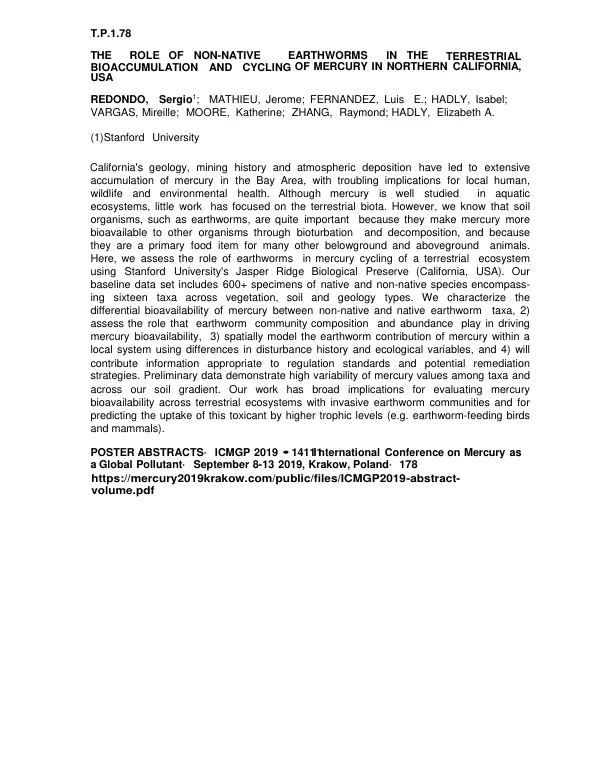
The Role of Non-Native Earthworms in the Terrestrial Bioaccumulation and Cycling of Mercury in Northern California, USA
Sign inUSAID DEC
The Role of Non-Native Earthworms in the Terrestrial Bioaccumulation and Cycling of Mercury in Northern California, USA
Mercury accumulation in the Bay Area of California is a significant concern due to the region's geology, mining history, and atmospheric deposition.
2019 · 1 pages
Sign in to readA free account is required to download.
Abstract
This has led to extensive mercury accumulation, posing risks to human, wildlife, and environmental health. While mercury is well studied in aquatic ecosystems, the terrestrial biota has received limited attention. However, soil organisms, such as earthworms, play a crucial role in mercury cycling through bioturbation and decomposition, making mercury more bioavailable to other organisms. A study conducted at Stanford University's Jasper Ridge Biological Preserve in California assessed the role of earthworms in mercury cycling in a terrestrial ecosystem. The research team collected over 600 specimens of native and non-native earthworm species, encompassing 16 taxa across various vegetation, soil, and geology types. The study aimed to characterize the differential bioavailability of mercury between non-native and native earthworm taxa, assess the impact of earthworm community composition and abundance on mercury bioavailability, and spatially model the earthworm contribution of mercury within the local system. Preliminary data from the study revealed high variability in mercury values among earthworm taxa and across the soil gradient. The research has significant implications for evaluating mercury bioavailability in terrestrial ecosystems with invasive earthworm communities and predicting the uptake of this toxicant by higher trophic levels, such as earthworm-feeding birds and mammals. The findings of this study will contribute to the development of regulation standards and potential remediation strategies for mercury contamination in terrestrial ecosystems. The study's focus on non-native earthworms is particularly relevant, as these species can alter ecosystem processes and potentially increase mercury bioavailability. By understanding the role of non-native earthworms in mercury cycling, researchers can better predict the impacts of invasive species on ecosystem health and develop effective management strategies to mitigate these effects. The Jasper Ridge Biological Preserve provides a unique opportunity to study the interactions between earthworms and mercury in a terrestrial ecosystem, shedding light on the complex relationships between soil organisms and mercury cycling.