USAID DEC
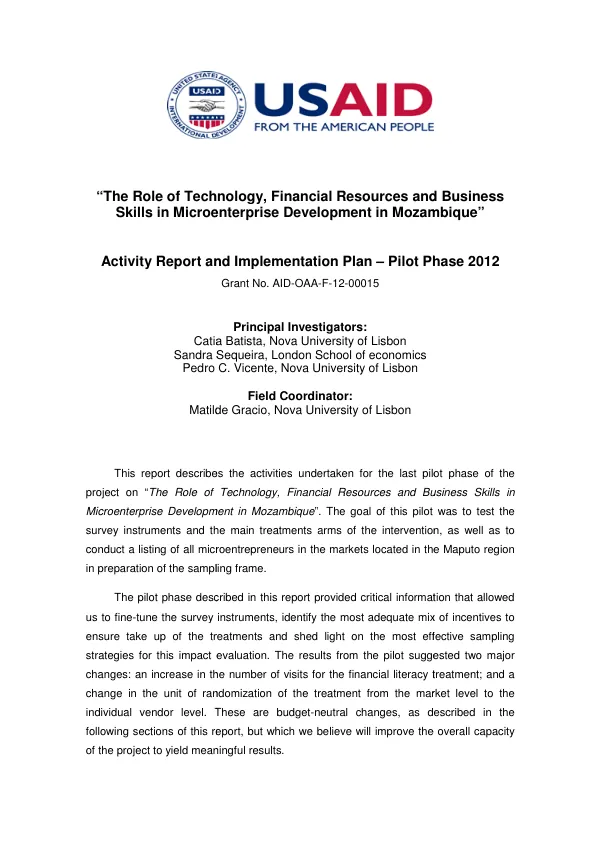
The Role of Technology, Financial Resources and Business Skills in Microenterprise Development in Mozambique
Sign inUSAID DEC
The Role of Technology, Financial Resources and Business Skills in Microenterprise Development in Mozambique
The pilot phase of the project on "The Role of Technology, Financial Resources and Business Skills in Microenterprise Development in Mozambique" was conducted in two markets of the city of Maputo in Mozambique: Mercado do Povo and Mercado do Polana-Caniço.
2012 · 87 pages
Sign in to readA free account is required to download.
Abstract
These markets are average sized and representative of the universe of markets in the capital in terms of the type of vendors who operate therein and of the overall market-level infrastructure. The pilot was conducted among 8 vendors, corresponding to two vendors per treatment. The main treatments arms of the intervention were financial literacy and mobile money (mKesh) treatments. The financial literacy treatment consisted of four visits, during which the research team implemented the baseline questionnaire, conducted the financial literacy training program, distributed the financial logbooks, and encouraged vendors to track their expenses, credit sales, and revenue on a regular basis. The mKesh treatment was administered during the fourth visit, and individuals receiving both the financial literacy and the mKesh treatments faced a similar implementation schedule. A system of incentives for take-up was constructed and tested to ensure the effective implementation of treatments. The incentives included participation and commitment bonuses, which were designed to motivate microentrepreneurs to perform the incentivized tasks. The participation bonus on the financial literacy treatment was not perceived as an actual incentive, given that the purchase is done in ex post intervention environment. However, the commitment bonus on the financial literacy treatment triggered a positive reaction, although the effects were not directly translated into action due to doubts arising when market vendors attempted to fill in the financial logbooks on their own. The participation bonus of the mKesh treatment proved to be of crucial importance in gaining the confidence of individuals receiving this treatment. The commitment bonus of the mKesh treatment is more complex to explain, as it involves complex concepts and is applied in the context of a service that is brand new for the vendor. Vendors subject to both treatments were the most enthusiastic and more responsive to the incentives, as they realized the considerable amount of benefits that the different steps of the treatment contain. The targeted sample reacted enthusiastically to the idea of participating in the study, and improvements were devised to different segments in the treatment arms to achieve more positive responses from the targeted sample. The financial literacy treatment was always very much welcome, and targeted individuals gained renewed interest once they were shown the manual. The results from the pilot suggest that the number of visits for the financial literacy treatment should be increased to ensure that vendors have sufficient time to understand and implement the financial literacy program. The pilot phase of the project also tested the overall capacity of the research team to implement the study, and the results suggest that the team was able to conduct the study effectively. The study was able to collect data on the financial literacy and mobile money treatments, and the results suggest that the treatments were effective in improving the financial literacy and mobile money usage of microentrepreneurs. The study also tested the receptivity of microentrepreneurs to different treatment arms, and the results suggest that microentrepreneurs were more receptive to the financial literacy treatment than to the mobile money treatment. However, the results also suggest that the mobile money treatment was effective in increasing the usage of mobile money among microentrepreneurs. The study was able to collect data on the cost-effectiveness of the interventions, and the results suggest that the interventions were cost-effective. The study also tested the overall capacity of the research team to implement the study, and the results suggest that the team was able to conduct the study effectively. The study was conducted in two markets of the city of Maputo in Mozambique, and the results suggest that the markets are representative of the universe of markets in the capital in terms of the type of vendors who operate therein and of the overall market-level infrastructure. The study was able to collect data on the financial literacy and mobile money treatments, and the results suggest that the treatments were effective in improving the financial literacy and mobile money usage of microentrepreneurs.
Related documents