INTERNATIONAL FOOD AND POLICY RESEARCH INSTITUTE
The Supply of Inorganic Fertilizers to Small Holder Farmers in Mozambique
Agricultural mechanization has been rapidly growing in Bangladesh, with the share of area cultivated by tractors and power tillers increasing from 30 percent in the mid-1990s to 95 percent in 2015.
2016 · 4 pages
Sign in to readA free account is required to download.
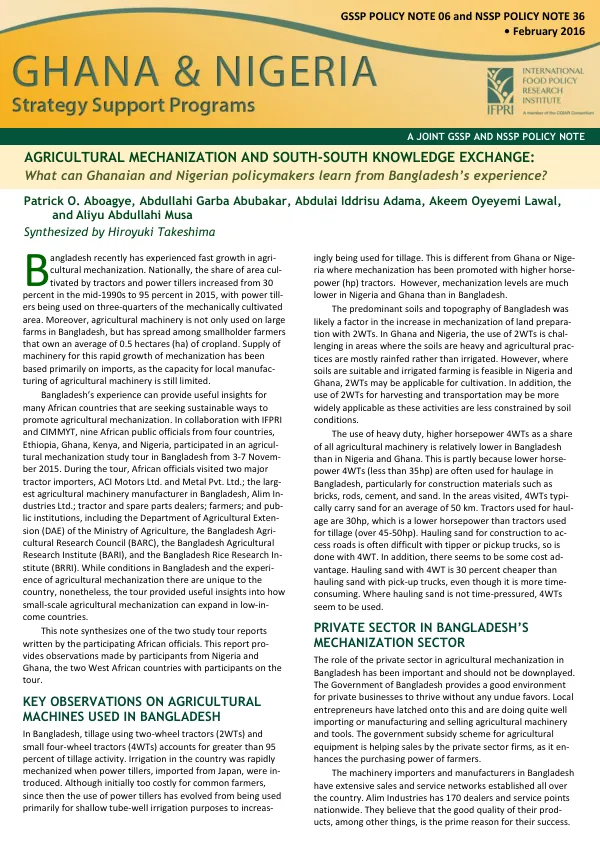
Abstract
Power tillers are used on three-quarters of the mechanically cultivated area, and agricultural machinery is not only used on large farms but also among smallholder farmers who own an average of 0.5 hectares of cropland. The supply of machinery for this rapid growth of mechanization has been based primarily on imports, as the capacity for local manufacturing of agricultural machinery is still limited. Bangladesh's experience can provide useful insights for many African countries seeking sustainable ways to promote agricultural mechanization. In 2015, nine African public officials from four countries, including Ghana and Nigeria, participated in an agricultural mechanization study tour in Bangladesh. During the tour, the officials visited major tractor importers, the largest agricultural machinery manufacturer, tractor and spare parts dealers, farmers, and public institutions, including the Department of Agricultural Extension and the Bangladesh Agricultural Research Council. The use of two-wheel tractors and small four-wheel tractors accounts for greater than 95 percent of tillage activity in Bangladesh. Irrigation in the country was rapidly mechanized when power tillers, imported from Japan, were introduced. The predominant soils and topography of Bangladesh were likely a factor in the increase in mechanization of land preparation with two-wheel tractors. In contrast, the use of two-wheel tractors is challenging in Ghana and Nigeria due to heavy soils and rainfed agricultural practices. The private sector has played an important role in agricultural mechanization in Bangladesh, with local entrepreneurs importing or manufacturing and selling agricultural machinery and tools. The government subsidy scheme for agricultural equipment has enhanced the purchasing power of farmers, and suppliers and importers offer after-sales service, credit, and diverse business portfolios. However, not all agricultural machines find a market in Bangladesh, with farmers rejecting combine harvester equipment due to high costs. Several government agencies collaborate in Bangladesh to achieve national agricultural mechanization goals, including the Bangladesh Agricultural Development Corporation, the Bangladesh Rural Development Board, and the Department of Agricultural Extension. These agencies share information and have harmonious working relationships, which is not the case in Nigeria, where overlapping functions lead to unhealthy rivalry among agencies. Ghana has mapped broad strategies on mechanization but lacks a policy on agricultural mechanization.