CARE
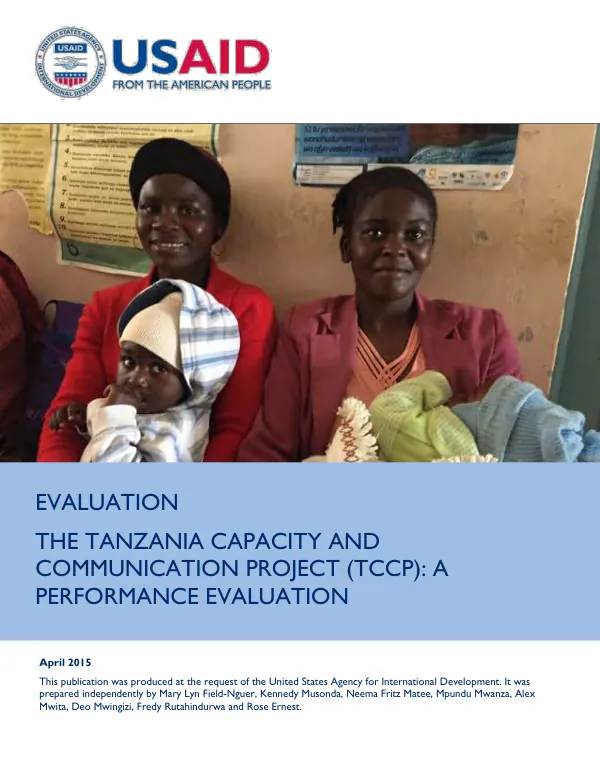
The Tanzania Capacity and Communication Project (TCCP): A Performance Evaluation
The Tanzania Capacity and Communication Project (TCCP) was a performance evaluation conducted in April 2015.
2015 · 136 pages
Sign in to readA free account is required to download.
Abstract
The project aimed to promote healthy behaviors and build social and behavior change capacity in Tanzania. The evaluation was designed to assess the project's effectiveness in achieving its objectives. The project was implemented in various regions of Tanzania, including Iringa, Njombe, Mwanza, and Dar es Salaam. The evaluation team conducted a comprehensive assessment of the project's activities, including interviews with stakeholders at the national, regional, and district levels of the Ministry of Health and Social Welfare. The team also gathered data from various sources, including reports, surveys, and focus group discussions. The evaluation focused on six key questions, including the project's impact on HIV prevalence, the effectiveness of behavior change communication, and the capacity of local organizations to implement health programs. The evaluation team used a mixed-methods approach, combining both quantitative and qualitative data to assess the project's outcomes. The findings of the evaluation revealed that the project had made significant progress in promoting healthy behaviors and building social and behavior change capacity in Tanzania. The project's behavior change communication activities had led to an increase in the use of condoms and a reduction in the number of new HIV infections. The project's capacity-building activities had also strengthened the capacity of local organizations to implement health programs, particularly in the areas of HIV prevention and treatment. The evaluation also identified several challenges and limitations of the project, including the need for more effective monitoring and evaluation systems and the need for greater community engagement and participation. The evaluation team made several recommendations to address these challenges, including the need for more targeted and effective behavior change communication activities and the need for greater support for local organizations to implement health programs. The project's funding was provided by the United States Agency for International Development (USAID), and the project was implemented by a consortium of local and international partners, including Johns Hopkins University-Center for Communication Programs and the Tanzania Communication and Development Center. The project's overall goal was to contribute to the reduction of HIV prevalence and the improvement of health outcomes in Tanzania. The evaluation team consisted of several experts in the field of health communication and capacity building, including Mary Lyn Field-Nguer, Kennedy Musonda, Neema Fritz Matee, Mpundu Mwanza, Alex Mwita, Deo Mwingizi, Fredy Rutahindurwa, and Rose Ernest. The team was supported by several USAID staff members, including Diana Harper and Joan Mayer. The evaluation report was prepared independently by the evaluation team and was not necessarily reflective of the views of the United States Agency for International Development or the United States Government. The report was intended to provide an objective assessment of the project's effectiveness and to inform future programming and policy decisions.