BANYAN GLOBAL
The Time is Now to Accelerate Women's Public Procurement: Snapshot: Kenya
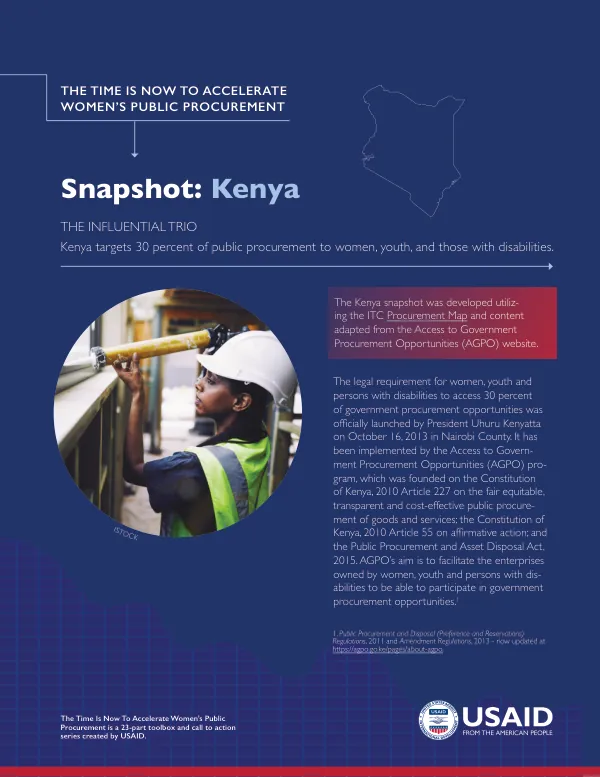
The Kenyan government has established a legal requirement for women, youth, and persons with disabilities to access 30 percent of government procurement opportunities.
2021 · 2 pages
Sign in to readA free account is required to download.
Abstract
This requirement was officially launched by President Uhuru Kenyatta on October 16, 2013, in Nairobi County. The Access to Government Procurement Opportunities (AGPO) program, founded on the Constitution of Kenya, 2010, aims to facilitate the participation of enterprises owned by women, youth, and persons with disabilities in government procurement opportunities. The AGPO program is based on the Constitution of Kenya, 2010, Article 227, which emphasizes fair, equitable, transparent, and cost-effective public procurement of goods and services. Additionally, the program is guided by Article 55, which promotes affirmative action. The Public Procurement and Asset Disposal Act, 2015, also supports the AGPO program. The program's objective is to enable women-owned enterprises, youth, and persons with disabilities to participate in government procurement opportunities. In Kenya, preference and reservation schemes may be applied by procuring entities to benefit "disadvantaged groups," including enterprises owned by women. Registration with the National Treasury or the respective county treasury is compulsory for women-owned businesses, which must have at least 70 percent membership of the business. The government has directed that 30 percent of procurement opportunities be awarded to youth, women, and persons with disabilities. Since the program began in 2013, 51 percent of special tenders have been awarded to women, valued at $302 million. Gloria Ndekei, Trustee and In Charge of Women Programmes for the Kenya Private Sector Alliance, highlighted the importance of inclusive trade in government procurement. She emphasized the need for affirmative action, prompt payment, creation of linkages between women-owned Micro, Small and Medium Enterprises and large enterprises, capacity building programs, access to finance, transparency, information, and supporting women-owned enterprises in the formalization of their business. Ndekei noted that the program has created a positive impact, with younger women emulating the role models who have benefited from the program, and even more women participating.
Related documents