USAID
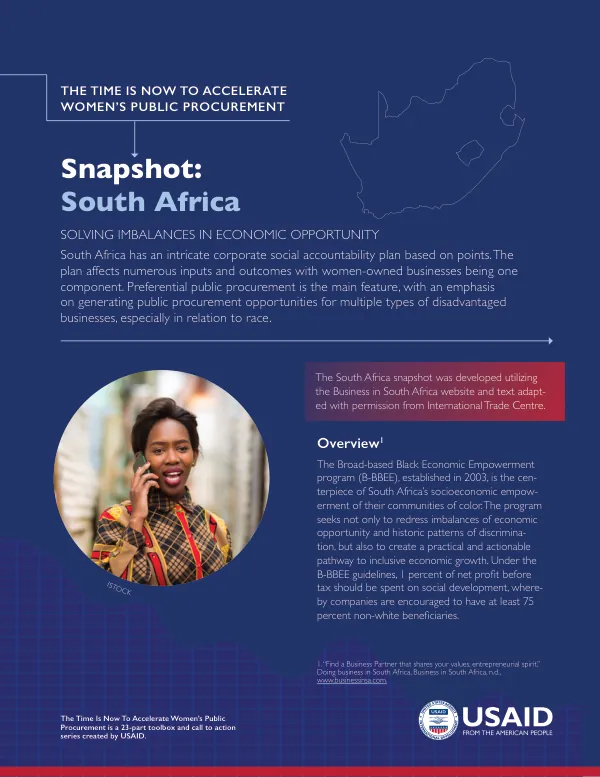
The Time is Now to Accelerate Women's Public Procurement: Snapshot: South Africa
The Broad-based Black Economic Empowerment program (B-BBEE) is the centerpiece of South Africa's socioeconomic empowerment of their communities of color.
2021 · 3 pages
Sign in to readA free account is required to download.
Abstract
Established in 2003, the program seeks to redress imbalances of economic opportunity and historic patterns of discrimination, while creating a practical and actionable pathway to inclusive economic growth. Under the B-BBEE guidelines, 1 percent of net profit before tax should be spent on social development, with companies encouraged to have at least 75 percent non-white beneficiaries. The B-BBEE program stimulates engagement with the underserved economic sector through strong incentives for companies to give back to the community through Corporate Social Investment. The platform uses a point ranking system across seven elements: ownership, management control, employment equity, skills development, preferential procurement, enterprise development, and socioeconomic development. The first phase of the codes encourages all entities, public and private, to implement proper B-BBEE initiatives through the issuing of licenses, concessions, sale of assets, and preferential procurement. Some commodities are set-asides for women-owned businesses, youth, and people with disabilities. The Central Supplier Database (CSD) is used by all government departments for public procurement. Registration on the CSD is mandatory for businesses that want to supply to the government, with the database providing information on the percentage of ownership by women, disabled individuals, and youth, by province, sector, and commodity. According to Regulation 4 of the Public Finance Management Act, preference will be given to women-owned businesses or qualifying small enterprises and exempted micro enterprises with 51 percent women ownership. Market analysis is used to inform tenders that fall under this regulation, with the same applying to subcontracting deals. Preferential schemes in place include preferential points allocated to women-owned businesses, reservations for women-owned businesses, youth, and people with disabilities, subcontracting plans with at least 30 percent allocated to women-owned businesses, and a goal to procure a percentage of spending from women-owned businesses, with more points for black women and previously disadvantaged people. The B-BBEE point system is complex and dynamic, requiring companies to always check for current information. The South African government has implemented various measures to promote women's public procurement, including the use of the CSD and the allocation of preferential points to women-owned businesses.
Related documents