USAID DEC
Thinking outside of the [cold] box: implementing a human-centered design approach to understand barriers and craft solutions to cold chain equipment maintenance in Niger
Sign inUSAID DEC
Thinking outside of the [cold] box: implementing a human-centered design approach to understand barriers and craft solutions to cold chain equipment maintenance in Niger
The human-centered design study in Niger aimed to understand the barriers to cold chain equipment (CCE) maintenance from the perspective of technicians directly involved in the process.
2023 · 9 pages
Sign in to readA free account is required to download.
![Thinking outside of the [cold] box: implementing a human-centered design approach to understand barriers and craft solutions to cold chain equipment maintenance in Niger](https://covers.devme.ai/gen/150085.webp)
Abstract
The study was conducted in two regions, Tahoua and Maradi, with a total of 20 in-depth consultations and two co-creation workshops involving 14 and 20 participants, respectively. The study objectives were to understand the entrenched obstacles limiting a reliable and functioning CCE maintenance system and to co-design a forward-thinking managed CCE maintenance system. The study found that the lack of system agility and ability to optimize resources constrain the performance of the maintenance system. Cold chain is often an afterthought within the overall context of immunization services and should instead be prioritized. Knowledge sharing across the system and key stakeholders is ad hoc with limited understanding of roles and responsibilities. The study identified four main concepts as potential solutions: creating an online platform to connect people and share knowledge across regions, developing practical CCE technical resources, using gamification and friendly competition to motivate staff to value maintenance, and creating a real-time maintenance tracking system. The study applied a human-centered design approach to engage people directly involved in CCE maintenance and to more deeply understand challenges with the current system. The results demonstrate that stakeholders can identify potential solutions that have not been part of the typical approaches to a maintenance system. This human-centered design approach has implications for all global health initiatives, highlighting the importance of engaging stakeholders in the design and implementation of solutions. The study was conducted in Niger, a country with over 1,100 health facilities providing immunization services, supported by over 2,000 pieces of CCE. The immunization program employs cold chain technicians to maintain the equipment, yet recognizes the maintenance system is underperforming. The program has recently contracted a private provider to outsource maintenance for larger equipment and higher volume sites at the regional level in an effort to address the gaps in the maintenance system. The study's findings and recommendations have the potential to improve the maintenance system in Niger and other low- and middle-income countries. The study's methodology, which engaged stakeholders in the design and implementation of solutions, demonstrates a promising approach for addressing complex health system challenges. The study's results highlight the importance of prioritizing cold chain maintenance and engaging stakeholders in the design and implementation of solutions to improve the performance of the maintenance system. The study's results demonstrate that stakeholders can identify potential solutions that have not been part of the typical approaches to a maintenance system. This human-centered design approach has implications for all global health initiatives, highlighting the importance of engaging stakeholders in the design and implementation of solutions. The study's findings and recommendations have the potential to improve the maintenance system in Niger and other low- and middle-income countries.
Related documents
Documents in this collection
 2021
2021USAID DEC
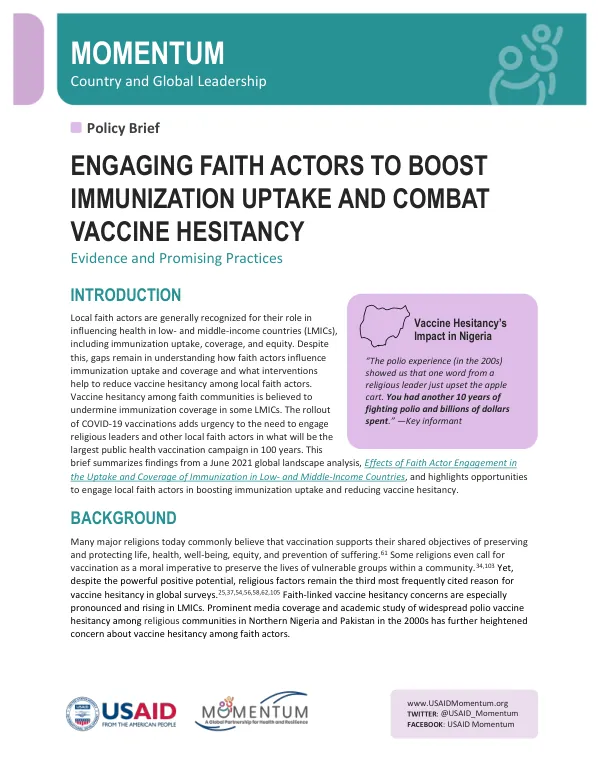
Policy Brief - Engaging Faith Actors to Boost Immunization Uptake and Combat Vaccine Hesitancy
Open record 2021
2021USAID DEC