USAID DEC
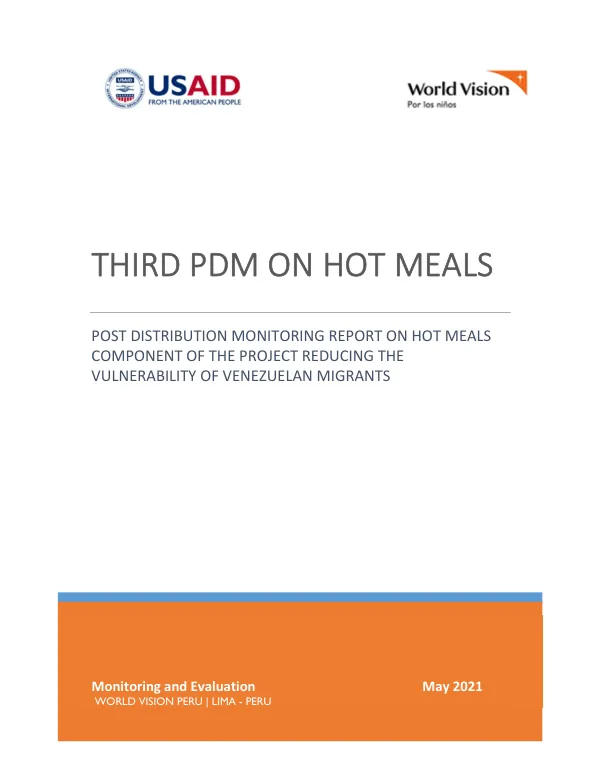
Third PDM Report: Post-Distribution Monitoring Report on Hot Meals
Migrants arriving in Peru frequently face substantial barriers to meeting their basic needs, such as food, shelter, hygiene, and health care costs.
2021 · 21 pages
Sign in to readA free account is required to download.
Abstract
According to the results of the ENPOVE survey carried out by the National Institute of Statistics and Informatics in 2018, 87.6% of the Venezuelan population in Peru required support to cover their basic needs. The Displacement Tracking Matrix (DTM) in Peru reported that up to 80% of migrants required daily medication, 85% did not have access to medical care, and 68.5% of people surveyed in Tumbes did not have access to food. Of those who were food insecure, 36% said their spending on food was more than 50% of their income. The COVID-19 pandemic has exacerbated entrenched vulnerabilities in Venezuelan migrants related to inadequate access to public services, food, shelter, poverty, limited economic opportunities, and unemployment. The government's response to the emergency has been limited, and humanitarian aid NGOs have been the primary providers of assistance. A large portion of Venezuela's migrants, most of whom work in the informal sector, have seen their livelihoods disrupted by movement restrictions and concerns about leaving home due to the risk of contagion and increased feelings of discrimination. The Post-Distribution Monitoring (PDM) survey was conducted to track progress in obtaining projected results and to support the generation of information for reporting. The survey was applied to 206 households that benefited from the hot meal service in the three project intervention areas: Lima, La Libertad, and Tumbes. The survey was carried out from March 30 to May 3, 2021, and covered households of the third group of beneficiaries who started receiving the hot meals service in the soup kitchens from February until the third week of April 2021. The survey collected information on food consumption and food availability, the use of hot meals by the beneficiary population, satisfaction with the process of distribution of meals, and knowledge and procedure of communication channels. The data registered from the Google Form were then processed using the Excel program, which allowed the generation of descriptive statistics such as percentages, frequencies, and proportions for the development of the analysis and the results presented in this document. The MEAL and EFSP II Operations team was responsible for this exercise, complying with the monitoring requirements to obtain information from the beneficiaries and community members to improve the provision of services. The sample of beneficiary households reached 206 households, distributed as follows: 155 in Lima, 21 in Tumbes, and 30 in La Libertad. The distribution of type of household by gender composition showed the distribution of households participating in the third rotation. The results of the survey showed that approximately 81.55% of the participants were females and 18.45% were males. 92.72% of the participants were of Venezuelan nationality and 7.28% were of Peruvian nationality. The survey also collected information on the characteristics of the surveyed households, including their food consumption and expenses before and after starting the project. The results of the survey will be used to improve the provision of services to the beneficiary population and to inform future programming decisions. The survey found that 92.72% of the households had a monthly income of less than 1,500 soles, and 71.63% of the households had a monthly income of less than 1,000 soles. The survey also found that 85.44% of the households had a household member who was working in the informal sector, and 63.55% of the households had a household member who was unemployed. The survey results will be used to inform future programming decisions and to improve the provision of services to the beneficiary population. The survey also collected information on the satisfaction of the beneficiaries with the project, including their satisfaction with the quality of the food, the frequency of the distributions, and the communication channels used by the project. The results of the survey showed that 85.44% of the beneficiaries were satisfied with the quality of the food, and 71.63% were satisfied with the frequency of the distributions. The survey results will be used to improve the provision of services to the beneficiary population and to inform future programming decisions.