USAID DEC
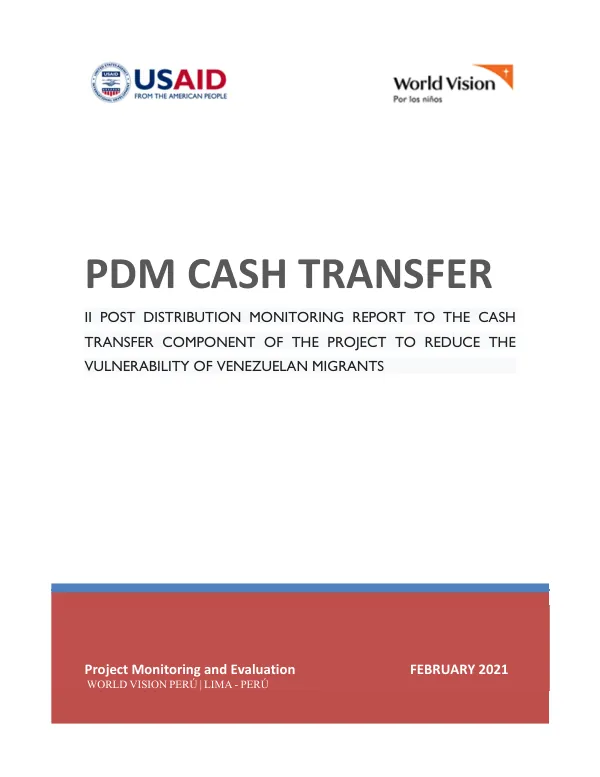
Post-Distribution Monitoring Report: Cash Transfer - New Participants
Migrants arriving in Peru are frequently unable to meet their basic needs, such as food, housing, hygiene, and health care costs, and face substantial barriers to earning income or to access services.
2021 · 33 pages
Sign in to readA free account is required to download.
Abstract
According to the results of ENPOVE carried out by the National Institute of Statistics and Informatics in 2018, 87.6% of the Venezuelan population need support to cover their basic needs. The most recent Displacement Tracking Matrix (DTM) in Peru indicates that up to 80% of migrants require daily medication, 85% of migrants do not have access to medical care, and 68% of people surveyed in Tumbes did not have access to food. The COVID-19 pandemic has exacerbated entrenched vulnerabilities in Venezuelan migrants related to inadequate access to public services, food, shelter, poverty, limited economic opportunities, and unemployment. A large portion of Venezuela's migrants, most of them working in the informal sector, are seeing how COVID-19 has disrupted their livelihoods, driven primarily by movement restrictions and concerns about leaving home due to the risk of contagion and increased feelings of discrimination. The Post-Distribution Monitoring (PDM) survey was conducted to track progress in obtaining projected results and to support the generation of information for reporting. The survey was applied in the three project intervention areas: Lima, La Libertad, and Tumbes. The information collection method was virtual to Venezuelan migrants referring to their main proposed indicators regarding the monetary transfer. The sampling frame is in relation to the database of participants of the OFDA II cash transfer program implemented by World Vision Peru and CARE Peru, having as unit of analysis the heads of households, holders, and who participate in this Post Survey Distribution. The surveys were applied to the heads of participant households, with respondents typically being the head of the household, the spouses of the head of the household, or an adult member of the household who is trained to answer questions about the project context and processes. The data recorded from the Google Form were then processed using the Excel application, which has allowed the generation of descriptive statistics such as percentages, frequencies, and proportions for the development of the analysis and the results presented in the current document. The OFDA II MEAL and Operations team has been responsible for this exercise, complying with the monitoring requirements in order to obtain information from participants and community members to improve service delivery. The specific objectives of the PDM exercise are to collect and analyze information on the working and household conditions of the migrant population benefiting from the second transfer, collect and analyze information on the use of second transfers by the participant population, collect and analyze information on Project Satisfaction by the participant population, and carry out a comparative analysis of the main variables between the 1st and 2nd PDM to new participants.