USAID DEC
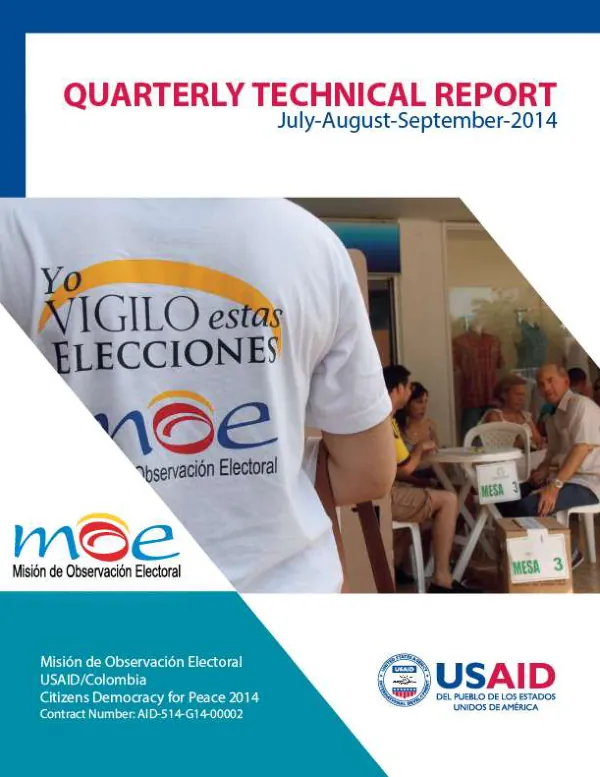
Third Quarterly technical report AID-514-G-14-00002
The Electoral Observation Mission (MOE) has been working to strengthen civil society's capacity to analyze electoral dynamics and produce early warnings.
2014 · 34 pages
Sign in to readA free account is required to download.
Abstract
During the third quarter of 2014, MOE's activities focused on information consolidation, elaborating reports and recommendations, and monitoring, analyzing, and presenting proposals on behalf of civil society for the Balance of Power Political Reform. MOE's platform of national and regional networks has had a significant impact on the entities involved in the project. In Congress and in other spaces for discussion and articulation between the Government of Colombia and Civil Society, MOE has been an important reference in discussions regarding electoral transparency, the improvement of the Colombian electoral system, the relationship between electoral politics and illegal forces, and the different electoral crimes and irregularities that have presented themselves in this year's elections. MOE has also been working to strengthen civil society's role in advocacy on issues related to the inclusion of women in the electoral process. The organization has produced a quantitative and qualitative analysis on political party compliance with gender quotas when creating their candidate lists and dissemination of the results of the analysis on women's political participation. Additionally, MOE has monitored gender inclusion by media outlets in at least three priority departments and carried out a survey with all women elected to Congress in 2014. MOE's research and production of information have also focused on the electoral process. The organization has elaborated and revised regional political power monographs that describe the local and departmental power structures and their relationships with legal and illegal actors. MOE has also elaborated reports about municipalities with guerrilla presence with a post-conflict perspective and made all historical information produced by MOE accessible to the public through the webpage www.datoselectorales.org. The reports and recommendations presented by MOE have proposed reforms in political and electoral issues. These reports have served as input for the documents and debates held in Congress regarding the balance of power reform, and many of the recommendations have been adopted by the National Government. The work done by MOE has materialized into legislative bills and even into legislative acts elaborated by Congress, indicating the important value added by the investigation and advocacy work done by the Electoral Observation Mission. MOE's primary objective is to get normal citizens to involve themselves and actively participate in politics. This purpose has been strengthened by the observation mission on days elections are held and with the www.pilasconelvoto.com tool. Thanks to the funding of this project, MOE was able to deploy 5,210 individual volunteers to lend their eyes and ears to the observation of transparent elections in 251 municipalities. MOE also received 4,321 electoral irregularity reports through the online tool, which are used by national and local authorities to better safeguard and prepare for the upcoming elections. MOE's analytical perspective allows the organization to view electoral processes as events related to long-term social, economic, and political dynamics. This perspective enhances the explanatory reach of the analysis when done from a local and regional point of view. MOE has divulged various documents about the post-electoral results, including "La Participación Política de la Mujer" (Women's political participation) and "Resultados electorales por regiones" (Electoral results by region). The comparative analysis of regional information has highlighted imbalances in political representation, particularly in the Piedemonte region and the South-East region. MOE's regional analysis of political and electoral information has allowed researchers to delve deeper into the different regions through decentralized investigative work. The organization has alliances with important academics, universities, and civil society organizations, including Red Prodepaz, a network of 19 CSOs with presence in 25 departments. The regional MOE observatories have been active in regions prioritized by USAID, as well as other regions that have maintained or have come on board to analyze the political and electoral dynamics.
Related documents