USAID DEC
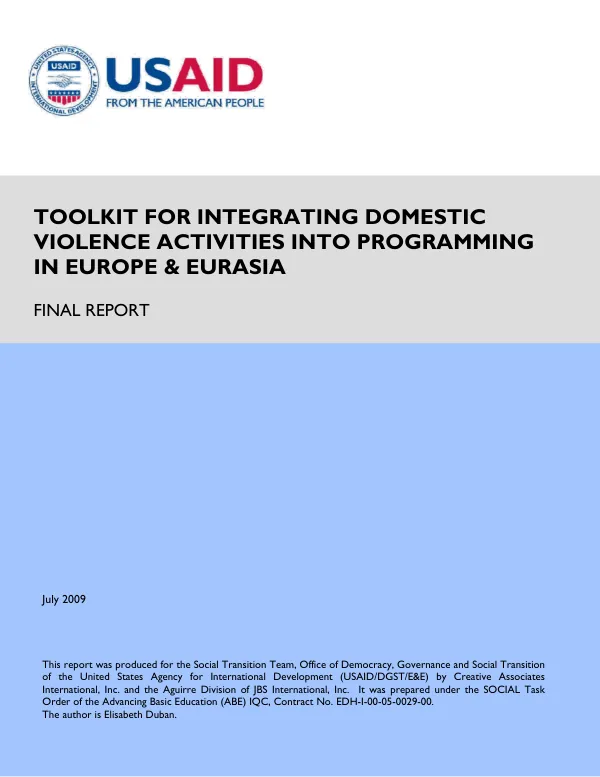
Toolkit for Integrating Domestic Violence Activities into Programming in Europe & Eurasia
Sign inCREATIVE ASSOCIATES INTERNATIONAL INC.
Toolkit for Integrating Domestic Violence Activities into Programming in Europe & Eurasia
The toolkit for integrating domestic violence activities into programming in Europe and Eurasia is a comprehensive guide for development practitioners, policymakers, and program managers.
2009 · 64 pages
Sign in to readA free account is required to download.
Abstract
The document is a result of a collaborative effort between Creative Associates International, Inc. and the Aguirre Division of JBS International, Inc. The toolkit emphasizes the importance of addressing domestic violence as a cross-cutting issue in development programming. It highlights the need for a multi-sectoral approach that incorporates various sectors, including health, economic growth, and economic growth. The toolkit is organized into several sections, including an introduction, which provides an overview of the issue of domestic violence and its impact on individuals, families, and communities. The introduction also discusses the purpose and scope of the toolkit, as well as the methodology used to develop it. The toolkit provides a framework for integrating domestic violence activities into programming, including guidelines for data collection and research, as well as strategies for addressing domestic violence in various sectors, such as health, economic growth, and economic growth. The toolkit also highlights the importance of addressing domestic violence in the context of post-conflict reconstruction, and provides guidance on how to integrate domestic violence activities into programming in this context. The toolkit concludes by emphasizing the need for a comprehensive approach to addressing domestic violence, and provides recommendations for policymakers, development practitioners, and program managers. The toolkit is a valuable resource for anyone working on domestic violence issues in Europe and Eurasia, and provides a framework for integrating domestic violence activities into programming. The toolkit covers various sectors, including: * Health: The toolkit provides guidance on how to address domestic violence in the context of health, including maternal and child health, family planning, and HIV/AIDS. * Economic growth: The toolkit provides guidance on how to address domestic violence in the context of economic growth, including microfinance and small business development. * Vulnerable groups: The toolkit provides guidance on how to address domestic violence in the context of vulnerable groups, including children, women, and children with disabilities. * Trafficking in persons: The toolkit provides guidance on how to address domestic violence in the context of trafficking in persons. * Post-conflict reconstruction: The toolkit provides guidance on how to address domestic violence in the context of post-conflict reconstruction. The toolkit provides a framework for integrating domestic violence activities into programming, including guidelines for data collection and research, as well as strategies for addressing domestic violence in various sectors. * Vulnerable groups: The toolkit provides guidance on how to address domestic violence in the context of vulnerable groups,
Related documents