USAID
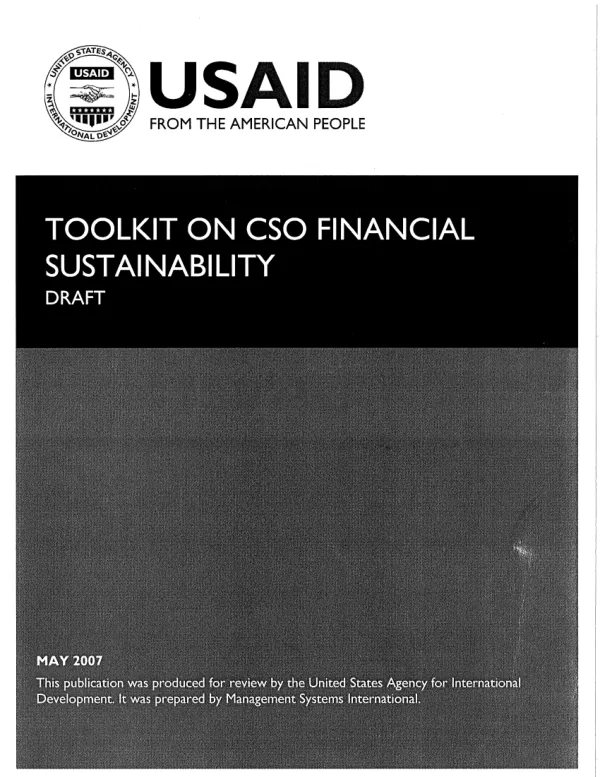
Toolkit on CSO financial sustainability : draft
Financial sustainability for civil society organizations (CSOs) remains a significant challenge worldwide.
2015 · 20 pages
Sign in to readA free account is required to download.
Abstract
The U.S. Government has been at the forefront of efforts to build local capacity and create a vibrant, effective, and durable civil sector. Despite increasing financial support from the U.S. for the CSO sector, there is concern about recipient organizations' dependence on U.S. and foreign donors, particularly in regions where funding is scarce and/or donors are "graduating'' countries. The toolkit on promoting financial sustainability for pro-democracy CSOs involved in advocacy and watchdog activities draws from a larger study conducted for USAID's Office of Democracy and Governance by Management Systems International. The study focuses on democracy-oriented advocacy and watchdog CSOs, which are the most dependent on international donors due to their limited access to local funding sources. A significant share of the examples cited in the toolkit is drawn from the former Communist countries of Central and Eastern Europe (CEE), where foreign donors have prioritized democratic consolidation and sustainability. The study employed a hybrid approach, combining key-informant interviews, a review of academic literature, and case studies of organizations across various geographic regions. The inquiry's initial scope was narrowed to focus on financial sustainability, as this dimension presents the greatest challenge for CSOs worldwide. The study recognizes that the durability of advocacy and watchdog organizations is linked to factors such as their public image, the prevailing legal framework, and the extent of volunteerism and a culture of philanthropy. Financial sustainability is defined as the ability of CSOs to secure the resources needed to carry out their mission over an extended period. The goal is to build an effective CSO sector capable of influencing government decision-making and the country's political development. While capable groups are often able to attract funding from various sources, democracy and human rights groups face significant challenges in securing adequate funding from local sources. Relaxing the definition of financial sustainability to include diversification of foreign support is necessary, as this can reduce a group's vulnerability and provide a platform for launching a multi-pronged financial viability strategy. The toolkit focuses on democracy-promoting advocacy and watchdog CSOs, which are essential to democratic consolidation. These organizations face significant hurdles in generating resources locally, and their survival is often dependent on international donors. The study recognizes that the most capable groups are those that are best able to attract funding from various sources and generate income through different means. However, the relationship between capability and funding is not always straightforward, particularly for democracy and human rights groups. The toolkit is designed as a compact, practical guide for USAID Missions and Washington-based staff to assist in developing and implementing programs to enhance CSO financial sustainability. The study draws from lessons learned and best practices worldwide, with a focus on the unique constellation of conditions in each country. The comparative perspective informs the toolkit and yields insights into what approaches are more likely to be successful in different settings. The toolkit emphasizes the importance of introducing concerns about financial viability from the outset, ensuring a conducive legal environment, and diversifying foreign donors. Cultivating local donors and building a loyal constituency are also crucial for financial sustainability. Generating income and building a strong public image are essential for CSOs, as is building capable organizations and encouraging a culture of philanthropy and volunteerism.