USAID DEC
Tools for Strengthening Country-led Interventions to Reduce Micronutrient Malnutrition
Sign inUSAID/CAMBODIA
Tools for Strengthening Country-led Interventions to Reduce Micronutrient Malnutrition
In Cambodia, a concerted effort is needed to build knowledge and capacity to integrate quality and sustainable micronutrient interventions into the health system.
2011 · 3 pages
Sign in to readA free account is required to download.
Abstract
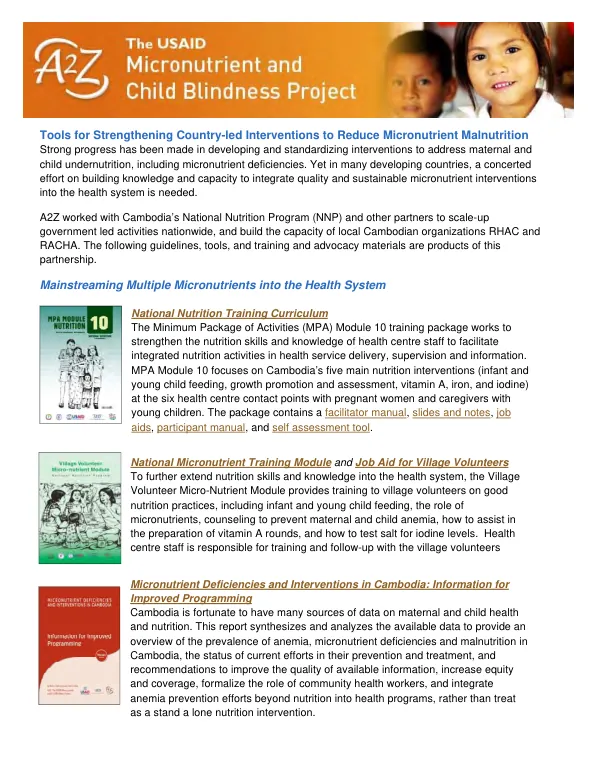
A2Z worked with Cambodia's National Nutrition Program (NNP) and other partners to scale-up government-led activities nationwide, and build the capacity of local Cambodian organizations RHAC and RACHA. The partnership resulted in the development of guidelines, tools, and training and advocacy materials. The Minimum Package of Activities (MPA) Module 10 training package is designed to strengthen the nutrition skills and knowledge of health centre staff to facilitate integrated nutrition activities in health service delivery, supervision, and information. MPA Module 10 focuses on Cambodia's five main nutrition interventions, including infant and young child feeding, growth promotion and assessment, vitamin A, iron, and iodine, at the six health centre contact points with pregnant women and caregivers with young children. The package contains a facilitator manual, slides and notes, job aids, participant manual, and self-assessment tool. To further extend nutrition skills and knowledge into the health system, the Village Volunteer Micro-Nutrient Module provides training to village volunteers on good nutrition practices, including infant and young child feeding, the role of micronutrients, counseling to prevent maternal and child anemia, how to assist in the preparation of vitamin A rounds, and how to test salt for iodine levels. Health centre staff is responsible for training and follow-up with the village volunteers. Cambodia is fortunate to have many sources of data on maternal and child health and nutrition. The report synthesizes and analyzes the available data to provide an overview of the prevalence of anemia, micronutrient deficiencies, and malnutrition in Cambodia, the status of current efforts in their prevention and treatment, and recommendations to improve the quality of available information, increase equity and coverage, formalize the role of community health workers, and integrate anemia prevention efforts beyond nutrition into health programs.
Related documents