USAID
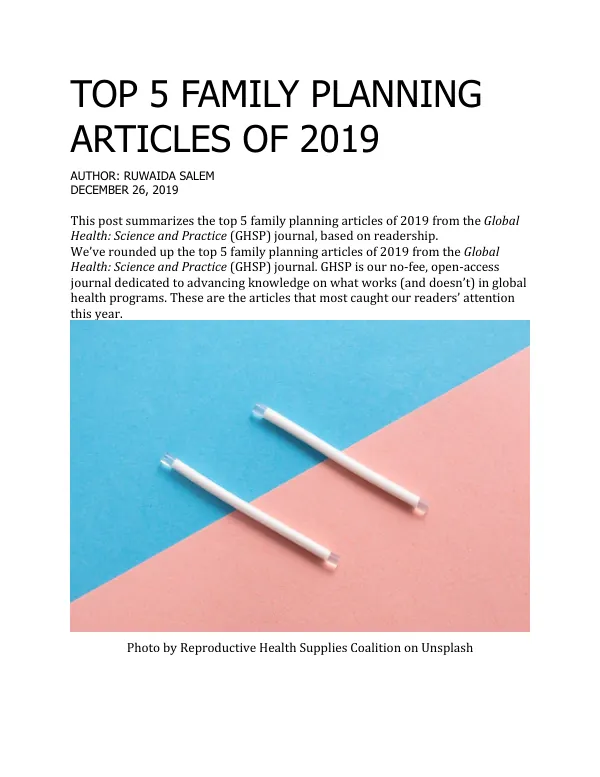
TOP 5 FAMILY PLANNING ARTICLES OF 2019
Family planning is a critical aspect of global health, particularly in low- and middle-income countries.
2019 · 9 pages
Sign in to readA free account is required to download.
Abstract
In 2019, several studies and commentaries were published in the Global Health: Science and Practice (GHSP) journal, highlighting key findings and recommendations in the field. One study assessed the adequacy of procured quantities of contraceptive implants, a long-acting method of family planning. The research found that while some countries, such as Ethiopia and Pakistan, ordered accurate quantities, others, like Burkina Faso and Ghana, did not, and a few, including Uganda, ordered too many. The study suggested that rapid increases in implant orders did not result in overstocks. Another study evaluated the impact of automated interactive voice messages promoting contraceptive use among women in Bangladesh who had undergone menstrual regulation. The intervention did not increase contraceptive use but had an unintended consequence of increasing self-reported intimate partner violence. The researchers highlighted the need to consider potential negative impacts when designing and evaluating mHealth interventions. They also suggested using direct, closed-ended questions to measure intimate partner violence instead of open-ended questions. A prospective cohort study in social franchise clinics in Pakistan and Uganda found a positive association between the quality of contraceptive counseling and method continuation rates. The study used the Method Information Index (MII), which measures the quality of counseling, and found that higher MII scores were associated with higher method continuation rates. The study's findings suggest that improving the quality of counseling can lead to better family planning outcomes. The Implementing Best Practices (IBP) Initiative is a partnership dedicated to supporting the dissemination and use of evidence-based family planning and reproductive health guidelines, tools, and practices. The initiative was created in 1999 with support from the World Health Organization, the U.S. Agency for International Development, and the United Nations Population Fund. The IBP Initiative is an example of a long-term partnership that has achieved significant progress in advancing global health goals. Provider bias in family planning refers to attitudes and behaviors by providers that unnecessarily restrict client access to and choice of contraceptive methods. A review of the literature on provider bias found that provider bias is a widespread issue, with underlying causes including provider attitudes, training, and training materials, as well as client characteristics, such as age and education level. The review proposed a clear definition of provider bias as a starting point for measuring the problem and evaluating the effectiveness of interventions to address it.